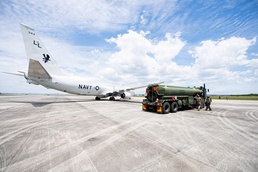
NAS JACKSONVILLE, Fla.- Navy Expeditionary Warfighting Development Center (NEXWDC) and Navy Expeditionary Logistics Support Group (NAVELSG) forces conducted a Limited Objective Experiment (LOE) at Naval Air Station Jacksonville, Florida, to evaluate expeditionary refueling solutions supporting P-8A Poseidon operations in an austere environment, April 21 to May 1, 2026.
Led by NEXWDC, whose mission is to develop and strengthen the U.S. Navy’s expeditionary force, the experiment brought together Navy Cargo Handling Battalion (NCHB) 1 and 2nd Navy Expeditionary Logistics Regiment to validate refueling operations under specified environmental conditions and in expeditionary settings where traditional infrastructure may be limited or unavailable.
“Fleet and joint commanders were asking for a capability that could ‘bring the fuel to the fight’ under contested conditions, rather than forcing platforms to withdraw to fixed refueling points,” said Capt. Joseph “Karl” Haywood, commanding officer, NEXWDC. “The limited objective experiment was designed to test whether the Navy’s expeditionary force could meet that demand with sufficient speed, survivability and scalability.”
The effort was designed to assess how expeditionary logistics forces can integrate into a joint environment to support specialized aircraft, extend operational reach and improve the endurance and utility of critical aviation platforms in theater. It also served as a testbed for NAVELSG to evaluate how expeditionary refueling solutions can be incorporated into the organization’s evolving force design and future operational capabilities.
“Our crew adapted extremely well throughout the LOE with all teams involved, which was very important in validating the evolution,” said Chief Aviation Boatswain’s Mate (Fuel) Tony Patterson, the LOE fuel’s supervisor, NCHB-1. “This opportunity also provided our expeditionary refueling team hands-on experience with equipment and platforms we usually do not operate, which was an invaluable experience.”
The P-8A Poseidon provides critical maritime patrol, reconnaissance and anti-submarine warfare capabilities. Enabling the aircraft to receive fuel support outside fixed, fully-developed infrastructure enhances survivability, preserves operational flexibility and supports continued presence in contested or distributed maritime environments.
The LOE also supports the continued development of Navy Expeditionary Combat Command and NAVELSG under the Navy’s evolving organizational construct. By using a realistic scenario, participating units evaluated how emerging capabilities can be integrated across the joint force, while identifying practical expeditionary refueling solutions that can be refined and scaled for future employment.
Tactics, techniques and procedures used during the event were based on courses of action developed by Maritime Patrol and Reconnaissance Weapons School. This kept the effort aligned with fleet requirements and operational needs. The approach helped tie the experiment to real-world missions and produced data to inform future doctrine, training and process improvements.
“This event represents a major step toward validating performance and shaping future Navy Tactics, Techniques, and Procedures,” said Lt. Adrian Arango, the LOE lead planner, NEXWDC. “The energy, professionalism and teamwork throughout have been exceptional.”
NAVELSG units played a central role in the experiment by providing the expeditionary logistics backbone necessary to execute the mission. NAVELSG provides global, rapid-response expeditionary logistics capabilities, including cargo handling, transportation and ordnance support for Navy and joint forces, with a mission focused on sustaining combat operations and delivering logistics at the point of need.
More broadly, the event demonstrated how expeditionary Navy forces can integrate with joint and Marine Corps partners to support specialized aircraft in challenging environments while advancing logistics modernization efforts across the force. The results are expected to help inform future standard operating procedures and provide additional insight for refining expeditionary refueling concepts, improving interoperability and increasing readiness.
As the Navy continues to prepare for operations in distributed and contested environments, efforts like this demonstrate the value of developing expeditionary refueling solutions that give operational commanders greater flexibility and help ensure essential aircraft remain mission capable in theater.
For more information about NAVELSG, visit the official command webpage at necc.usff.navy.mil/NAVELSG.