FORT DETRICK, Md. – Service members operate in austere environments, face high physical demands, and experience an increased risk of injury, often under cultural pressure to return to duty as quickly as possible. Severe musculoskeletal injuries are common, prompting researchers to explore ways to speed recovery through innovations in medical devices and rehabilitative treatment. Recovery, however, is more than healing; it requires regaining the strength, endurance, and confidence needed to return to the fight.
Dr. Michelle Lockwood, a researcher with Defense Health Agency Research and Development’s Extremity Trauma and Amputation Center of Excellence, studies outcomes related to the improvement of musculoskeletal injuries. Together with her colleague Dr. Molly Baumann’s efforts to develop and validate clinical measures that track rehabilitation progress and outcomes, they are researching how warfighter rehabilitation transforms through innovative approaches like the Intrepid Dynamic Exoskeleton Orthosis device and the Return to Run Program at the Center for the Intrepid.
“Our focus is on improving recovery and readiness for the warfighter with complex musculoskeletal injuries,” said Lockwood. “It’s not just about treating the injury, it’s about helping service members regain function, return to duty, and maintain long-term health. Ultimately, we want to restore capability, independence, and quality of life for those who serve.”
The EACE clinical Two-Minute Walk study led by Lockwood followed a structured process to evaluate the effectiveness of the IDEO and the Return to Run program for injured Service Members. Initially, participants completed the two-minute walk test – a straightforward assessment that measures how far an individual can walk in two minutes, to establish a baseline for their functional mobility.
Following this initial evaluation, each participant was fitted with the IDEO, a custom-fabricated device engineered to support gait mechanics and alleviate pain for individuals with significant lower extremity injuries. Constructed from lightweight carbon fiber, the IDEO features a dynamic strut that stores energy during the stance phase of walking and releases it during push-off, thereby enhancing mobility and reducing discomfort.
“We wanted to see, was it the IDEO alone or was it the device combined with the Return to Run program that really made the difference?” said Lockwood. “Our findings showed that it was really the combined approach—the rehabilitation and the IDEO—that allowed us to return individuals to a healthy, age-matched walking distance. That’s a significant step forward for our injured Service Members.”
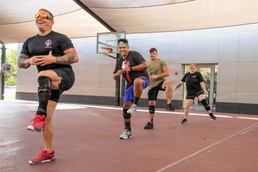
After receiving their IDEO, patients were enrolled in the Return to Run program, a demanding, four-week, sports-oriented rehabilitation protocol designed specifically for Service Members recovering from severe musculoskeletal injuries. Participants engaged in physical activity for four and a half days each week, with daily sessions lasting up to six hours. The program incorporated a variety of agility drills, resistance band exercises, directional changes, football sled pushes, and platform jumps, all aimed at challenging both the individual and the IDEO device. In the afternoons, participants transitioned to physical therapy, where they focused on strength training with weights and received individualized attention to address specific functional deficits. This level of intensity and customization was noticeably different from typical civilian rehabilitation programs, reflecting the unique physical demands and readiness requirements of the warfighter.
Upon completion of the Return to Run program, participants performed the two-minute walk test a final time, allowing researchers to measure the cumulative impact of both the IDEO and the rehabilitation protocol on their functional outcomes.
“We’re always looking for ways to track progress that are both meaningful and practical. The two-minute walk test is a validated measure that doesn’t require a lot of equipment or time, so it fits well into a clinical environment. It allowed us to see, in a very tangible way, how the combination of the IDEO and the Return to Run program improved walking distance and, ultimately, clinical outcomes for our patients,” said Baumann.
Service members who completed the IDEO intervention and the high-intensity Return to Run program showed significant improvements in walking distance and endurance, which allowed them to return to healthy, age-matched mobility levels. These gains directly translated into functional capacity, as individuals with severe musculoskeletal injuries were able to return to active duty—benefiting from improved mobility, greater endurance, and increased confidence in movement. These being key factors for effective deployment and mission performance, demonstrating that the combined clinical approach worked.
“It’s exciting to see these kinds of functional gains in a population that has faced such significant injuries. The ability to restore mobility and confidence not only impacts their physical health, but also their readiness and quality of life as warfighters” said Lockwood.
Further validation came from a companion study conducted over several years. In this follow-up, 145 individuals who participated in the program were surveyed by phone. 67% reported they returned to duty and 55% continued use of the IDEO. Over 90% of those surveyed kept their limbs, demonstrating that the combined clinical approach not only supported their return to duty but also helped prevent amputations down the road. Looking ahead, Baumann sees the future of warfighter rehabilitation as increasingly personalized, leveraging data and clinical insights to tailor care for each individual’s unique needs. She emphasizes that the path to optimal recovery will not be a one-size-fits-all, given the complexity and variability of injuries sustained in a fighting environment.
“The next steps in warfighter rehabilitation are about understanding how much rehabilitation is needed to see improvements in functional performance and figuring out what that actually is for an individualized approach,” said Baumann. “These injuries are complex and unique to each individual, so patients will start at different baselines. We want to make sure we’re not over-treating, but not under-treating either. Ultimately, our goal is to deliver the right care, at the right time, for every warfighter, so they can return to duty and life with the best possible outcomes.”
As Lockwood and Baumann’s work shows, combining innovative devices with individualized, intensive rehabilitation restores function and enables service members to return to duty. Their research is shaping the future of warfighter rehabilitation, ensuring science serves those who serve.