Two top U.S. military generals highlighted the vital role of space capabilities in enabling U.S. and partner nation efforts to address shared threats in the Western Hemisphere during their opening remarks at the Space Conference of the Americas.
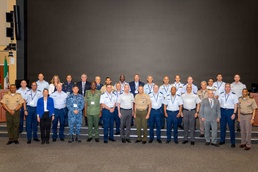
The commander of U.S. Southern Command (SOUTHCOM), Gen. Francis L. Donovan, and the commander of U.S. Space Command (USSPACECOM) Gen. Stephen N. Whiting, addressed a gathering of senior multinational military space leaders at the conference hostedat SOUTHCOM headquarters in Doral, Florida, April 28. The conference, held April 28-30, aimed to strengthen regional cooperation and advance shared space-related goals and included 15 nations from the Western Hemisphere along with additional global allies.
“Military strategy has long recognized the importance of controlling the high ground,” Gen. Donovan said. “In the 21st century, that high ground is space. We must seize the initiative to ensure supremacy over our adversaries in this key domain.”
Whiting also acknowledged the growing realization of space as the key domain to maintain superiority in modern warfare.
“While our founding fathers were brilliant, visionary leaders, I find it hard to believe that George Washington and Thomas Jefferson could have ever predicted the need for a war fighting command dedicated to the domain of space,” Gen. Whiting said.
While the rest of the United States’ geographic combatant commands’ areas of responsibility can be easily identified on a map, USSPACECOM’s astrographic area of responsibility is the so-called “high ground” – extending from 100 kilometers above the Earth’s surface, to infinity.
Dominating and utilizing the high ground will make it possible for the United States and its partners to counter the influence of malign state actors like Russia and China, Gen. Donovan added.
“China continues its malign activities via the Belt and Road Initiative to project hard power and threaten key terrain. The Western Hemisphere now hosts the largest collection of Chinese-built space infrastructure outside of mainland China, a direct result of the [Chinese Communist Party’s] understanding of this region's importance to its global ambitions,” Gen. Donovan said.
“Together, we send an unmistakable message,” Gen. Donovan said. “To our partners, it is a message of shared responsibility. And to our adversaries, it’s a message of shared resolve.”
Gen. Donovan also highlighted how space capabilities are currently delivering "real-world impact" in efforts to disrupt cartels and narco-terrorist networks in the region. He described how the Ecuadorian military recently used a U.S. Space Force satellite system to identify and successfully destroy three clandestine airfields used by the cartels. "That is space power directly enabling ground-truth success," he said.
"The key for us right now, as we look at these narco-terrorist networks, and we think about our actions from point of production to point of delivery in the plazas on the border of the U.S., we want to impose total systemic friction on those networks. And I believe our space capabilities will enable that," Gen. Donovan said.
Both generals said technological advances in space influence and improve the everyday lives of most people around the globe. Unfortunately, the ambitions of China and Russia to gain additional space orientated footholds in the Western Hemisphere highlight the need for the United States and its partner nations to work together to secure the space domain and preserve its neutrality.
“Most concerning of all,” Gen Whiting added, “Russia reportedly has plans to violate the Outer Space Treaty by launching a satellite capable of carrying a nuclear weapon in space. A nuclear weapon on orbit is unconscionable.” Threats in the space domain are not the only concern, Gen. Whiting said. A joint force across the Western Hemisphere will combat terrestrial threats as well.
“We have a moral responsibility to provide space enabled solutions to address the terrestrial threats that compromise our way of life,” Gen. Whiting said. “And there are three terrestrial threats within this hemisphere … that space capabilities can help address, narco-terrorism, illegal mining, and illegal fishing.”
By fostering dialogue and partnerships, the Space Conference of the Americas is supporting joint projects, data sharing, and the development of regional space capabilities. It also provides a platform to address policy and regulatory challenges, promote responsible space activities, and reinforce diplomatic ties among participating nations, he said.
“I stand here proud of the progress we have collectively made,” Gen. Whiting concluded. “But knowing there is work still to be done, empowering each nation with training and capabilities.”
The Space Conference of the Americas brought senior military space leaders and representatives from Argentina, Brazil, Chile, Colombia, Ecuador, Mexico, Paraguay, Peru, and Uruguay. Alongside Latin American space leaders, senior representatives from Canada, France, the Netherlands, and the United Kingdom are participating, as well as invited observer countries including Costa Rica, Panama, the Dominican Republic, Suriname, and Guyana. Additionally, observer delegations from Australia, Germany, New Zealand, Angola, Kenya, Morocco, and Nigeria were present.