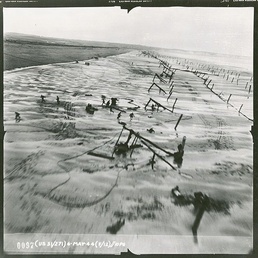
On May 6, 1944, pilots from the 10th Photo Reconnaissance (PR) Group began a series of low-altitude missions over the beaches in northern France in preparation for the Allied invasion. These dangerous operations providedD-Day planners with critical aerial intelligence about the terrain and German defenses Allied troops would face one month later.
Prior to the spring of 1944, photo reconnaissance in the European Theater had primarily been utilized to identify strategic air targets such as bridges, railways, transportation routes, and airfields in northwest France. As the date of the invasion drew nearer, Allied planners required more detailed information on the positions of German ground forces and their defensive capabilities on the beaches in Normandy.
The 10th PR Group was one of the units tasked with reconnoitering the beachhead over an extended area between France and Belgium to obscure the intended location of the invasion. Pilots flew the F-5 Lightning, a variant of the P-38 Lightning twin-engine aircraft, stripped of armaments and retrofitted with cameras and a larger fuel tank. While this kept the planes light, allowing them to reach higher speeds and altitudes for longer periods, it left the pilots at significant risk if targeted by enemy planes or antiaircraft fire. The missions over the beaches were especially dangerous, as they were to be flown at low altitude, between 15 and 50 feet, at an average speed of 350 knots (~400 mph). These were known as “dicing” missions, as operations flown at such low heights, high speeds, and with no defensive capabilities were seen as rolling the dice with pilots’ lives.
The first of these dicing missions was flown on May 6, 1944 by 1st Lt. Albert Lanker of the 31st PR Squadron. Surprising the Germans on the beach at Berck-sur-Mer, Lanker’s photos distinctly showed German gun emplacements on the nearby cliffs and explosive mines scattered across the beachhead. He reportedly cleared the cliff on his exit by just 6 feet. On another mission, 2nd Lt. Allen R. Keith, 34th PR Squadron, collided with a seagull, which shattered the plane’s windscreen. He nevertheless returned with photos that showed “wood and concrete posts topped with teller mines connected with trip wire” and clear weaknesses in the German defenses near Le Havre.
On May 20, 2nd Lt. Garland A. York, 34th PR Squadron, photographed Omaha and Utah beaches, the precise location where American troops would land just two weeks later. According to unit commander Col. W. Donn Hayes, York’s photos showed obstacles specifically designed to stop landing crafts “within the killing zone of defensive German machine gun emplacements and steel hedgehogs as infantry stoppers.”
The 10th PR Group flew a total of eleven dicing missions between May 6–20, 1944, with two fatalities: 1st Lts. Fred K. Hayes and Richard E. Knickerbocker. Colonel Hayes outlined the significant intelligence contributions provided by these pilots in his journal:
"The detail of photos taken on these missions was such that, in the two weeks prior to the invasion, a scale model of Omaha Beach was built, complete with natural features of the beach trees, houses and other buildings, obstacles built by the Germans, as well as other enemy installations known to exist at the time. Along with low and high altitude photography, the area was studied and memorized by the Combat Engineers charged with the task of clearing the obstacles for the landing craft and invasion forces that would follow."
For “fearlessly pilot[ing] their aircraft over the difficult photographic runs in the face of intense fire from some of the strongest anti-aircraft installations in western Europe,” the 10th PR Group was awarded a Distinguished Unit Citation. Lieutenants Keith and York both received the Distinguished Flying Cross.
Article by Erin E. Thompson, USAICoE Staff Historian. New issues of This Week in MI History are published each week. To report story errors, ask questions, request previous articles, or be added to our distribution list, please contact: TR-ICoE-Command-Historian@army.mil.