On May 4, 1947, Genevieve Grotjan Feinstein resigned from the U.S. Army Security Agency (ASA). During her eight years with the organization, she made some of the most significant breakthroughs in both Japanese and Russian enciphered message traffic during World War II and the immediate postwar period.
Genevieve M. Grotjan was born in Buffalo, New York, on Apr. 30, 1913. After delivering the salutatorian’s address at her high school graduation, she enrolled in the mathematics program at the University of Buffalo, with a goal of teaching college math. She graduated summa cum laude in 1936 and started graduate studies but, before finishing, she accepted a job at the Railroad Retirement Board in Washington, D.C. In 1939, her life would take an exciting turn after she completed a routine civil service math test.
While Genevieve was calculating pensions for railroad employees, her math score caught the attention of William F. Friedman, chief of the Army’s Signals Intelligence Service (SIS), headquartered just a few blocks away. Friedman interviewed and then offered the 27-year-old a job with a salary of $2,000 per year. In October 1939, she joined Frank Rowlett’s team struggling to solve Japan’s newest diplomatic cipher.
After eleven months of painstaking work, on Sep. 20, 1940, Genevieve located a pattern in several Japanese messages that finally provided an entry point into the cipher. Her discovery allowed the SIS to build an analog machine to break Purple, Japan’s highest-level diplomatic cipher system. The breaking of Purple was heralded by Friedman as “by far, the most difficult cryptanalytic problem successfully handled and solved by any signals intelligence organization in the world.” Purple became one of the U.S. Army’s most important intelligence sources during World War II. The humble Genevieve remembered the effort with “satisfaction and pleasure.”
Genevieve continued working on Japanese modifications to the cipher, as well as the cipher systems of twenty-five enemy and neutral countries around the world. By 1943, however, her skills were needed on a different problem. Now Genevieve Grotjan Feinstein—she had married chemist Hyman I. Feinstein that year—transitioned to encrypted Russian message traffic for what would become known as Project Venona. Genevieve, as senior cryptanalyst on the team, noted the Russians reused fragments from the one-time pads to encrypt their messages. This discovery allowed the team to find other duplications and, eventually, the messages revealed extensive Soviet espionage networks in the highest levels of the U.S. government and in the highly classified Manhattan Project that developed the atomic bomb.
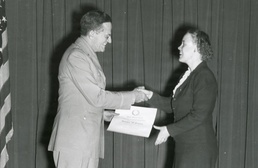
On May 3, 1946, Genevieve’s stellar achievements earned her an exceptional civilian service award. Due to the classified nature of her work, her commendation rather blandly praised her: "For developing and improving procedures in research and production which have accomplished extraordinary results for the War Department; for superior initiative and aptitude in fulfilling her assignments; and for exceptionally meritorious service within and beyond the call of duty in the interest of the war effort."
A year later, on May 4, 1947, Genevieve resigned from her civil service position to take her dream job as a professor of mathematics at George Mason University, where her husband also taught chemistry. Upon leaving the ASA, she was given a letter reminding her not to talk about her work. The letter, like her earlier commendation, gave little hint of the significance of her accomplishments: "The confidential nature of your work here prevents you from discussing it with anyone, even prospective employers. You may say that your position here was a Research Analyst (Crypt) and your duties were of a technical nature. You may also present this letter showing that your work was entirely satisfactory and your average efficiency rating was excellent."
Genevieve Grotjan Feinstein passed away on Aug. 10, 2006. She was inducted into the National Security Agency Hall of Honor in 2010.
Article by Lori S. Stewart, USAICoE Command Historian. New issues of This Week in MI History are published each week. To report story errors, ask questions, request previous articles, or be added to our distribution list, please contact: TR-ICoE-Command-Historian@army.mil.