The International Customer User Group (ICUG) has come a long way from its roots as a technical feedback session.
Since its inception nearly 30 years ago, the group has evolved from a small collective providing system-level input to the Defense Security Cooperation Agency into a crucial forum where foreign partners and U.S. agencies align on the most critical aspects of global security.
Originally established in 1999 to provide partner input on the Defense Security Assistance Management System, the ICUG’s scope has expanded exponentially. Today, its agendas have shifted from troubleshooting software interfaces to navigating the complexities of global logistics, multi-national policy, and rapid Foreign Military Sales case execution.
A Unified Voice for Global Partners
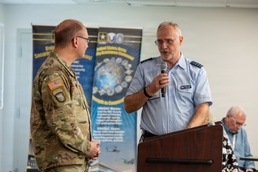
The ICUG’s growing influence was on full display at its most recent meeting in March. Hosted by the U.S. Army Security Assistance Command (USASAC) in New Cumberland, Pennsylvania, the event drew over 100 in-person attendees and another 100+ via virtual link. Among them were liaison officers from 24 partner nations, representing every geographic combatant command.
While the 24 nations present represent only a fraction of the 185 total FMS partners, Royal Netherlands Air Force Lt. Col. Peter Tijsen, an ICUG executive committee member and liaison officer at USASAC, emphasized that these voices carry the weight of the entire community.
“If we face a problem, the silent majority likely faces the same problem,” said Tijsen. “Even though there are a limited number of representatives in the room, we need to remember that the whole community is much larger and the problems we resolve impact the entire security cooperation enterprise.”
Breaking Barriers: Beyond Language and Policy
For many foreign liaison officers, navigating the labyrinth of U.S. FMS policy is a daunting task, particularly when English is a second language. The ICUG serves as a vital "translator" for these complexities, providing clarity and—importantly—access to key players in the FMS process.
Ron Weinberger was involved in the ICUG for most of his 38-year government career, including his time as director of international programs at the Naval Air Systems Command. Now working as a logistics consultant, he noted that this networking is indispensable.
“Liaison officers often have only a one-to-three-year window here and learning our processes can take most of that time,” Weinberger explained. "In today’s environment, we can’t afford such a lengthy learning curve. We need them to hit the ground running to support their countries, which is why the ICUG is so important.”
A Strategic Pivot to Readiness
The transformation of the ICUG arrives at a critical moment. A recent directive from the Secretary of War focused on arms transfer and security cooperation reform, stating that the global landscape demands the Department "leverage international partnerships to accelerate delivery of lethal capabilities... and expand the defense industrial base."
Underscoring this shift, the 98th ICUG featured a landmark presentation by two colonels from the U.S. Army War College on the critical role of logistics in Large-Scale Combat Operations (LSCO). This moved the conversation beyond day-to-day operational matters and toward the strategic reality of sustaining a prolonged fight.
Col. Aaron Brown highlighted logistics support as the key to battlefield supremacy and emphasized the importance of international cooperation and information sharing.
“Logistics vulnerabilities in LSCO are not just and American problem,” he noted. “They are a shared issue among Allies and Partners, requiring a multinational approach to develop a resilient logistics system that creates strategic advantages for a decisive victory.”
Prepared for Tomorrow
By expanding beyond the purely civilian-led technical discussions toward integrated military perspectives on readiness, the ICUG has proven it is no longer just a "user group." It is now a catalyst for strengthening alliances and ensuring that the global security assistance community is prepared for the high-stakes challenges of the future.