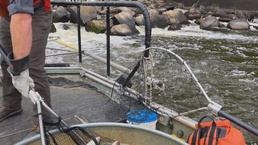
JORDAN LAKE, N.C. — A collaborative effort between the U.S. Army Corps of Engineers Wilmington District, The Nature Conservancy, and on-the-ground project staff is reshaping how water is managed along the Cape Fear River—improving conditions for fish, ecosystems, and communities downstream.
At the center of the effort is Jordan Lake, where USACE manages water releases to meet a wide range of mission requirements, including flood risk reduction, water supply, recreation, and water quality. Through the Sustainable Rivers Program, those operations are now being adapted to also support environmental outcomes like fish passage.
“So what we’re trying to do with our reservoir operations now, still working within our normal operation constraints… we’re trying to leverage releases from the reservoir to support flows downstream, to enable the fish to pass over the locks and dams,” said Ashley Hatchell, a hydraulic engineer with the Wilmington District.
Three lock and dam structures along the Cape Fear River create barriers for migratory fish species attempting to reach upstream spawning grounds. While water continues to flow over these structures, the difference in elevation prevents many species from successfully passing.
“We’re seeing fish populations decline 80 percent… and that includes an endangered species, sturgeon,” Hatchell said.
To address this challenge, USACE is working to adjust the timing and magnitude of water releases from Jordan Lake. By coordinating releases with natural rainfall and river conditions, water managers can create temporary flow conditions that allow fish to move upstream more effectively.
“It’s just a tweak in the timing and magnitude of the releases that we would normally make anyway,” Hatchell said.
In addition to supporting fish passage, the effort is also addressing water quality concerns that arise during periods of low flow and high temperatures—conditions that have become more common in recent years.
“When we have low water and really hot temperatures… it’s actually allowing these algal species to stay at the top, get more sunlight and bloom,” said Dr. Julie DeMeester, water program director for The Nature Conservancy’s North Carolina chapter.
These blooms can create taste and odor issues for drinking water utilities and, in some cases, develop into harmful algal blooms that pose risks to both humans and aquatic life.
By introducing controlled pulses of water, researchers and water managers are working to better understand how releases can help mix the water column and reduce the likelihood of these conditions forming across a 135-mile stretch of river.
The work is highly collaborative, combining engineering expertise from USACE with scientific research and stakeholder engagement led by The Nature Conservancy and other partners.
“The Army Corps is the largest manager of water in our country… and the Nature Conservancy is also the largest nonprofit working on environmental issues. So we paired together to try and use our talents to make the systems better for all,” DeMeester said.
On the ground, these adjustments require additional coordination and effort from project staff, but the impact can be significant.
“It’s been really gratifying to see the little extra labor that we have to do here… all coming together to have a pretty big impact,” said Dana Matics, assistant operations project manager for the Falls Lake Project.
Even small changes in releases at Jordan Lake can influence river conditions far downstream, demonstrating how interconnected the system is.
“It’s been really neat to see is a small release here… you wouldn’t think it would mean a big deal downstream. But the science and the research… has shown it does,” Matics said.
While the effort remains in a testing and evaluation phase, early results are promising. The long-term goal is to incorporate successful strategies into standard operating procedures, ensuring consistent benefits for fish populations and water quality in the future.
For project partners, the collaboration itself is a major success.
“We have talented people who are coming to the table and creating solutions that we never would have thought of as singular organizations,” DeMeester said.
As conditions across the basin continue to fluctuate between drought and heavy rainfall, that kind of adaptive, partnership-driven approach will be critical to managing water resources effectively.