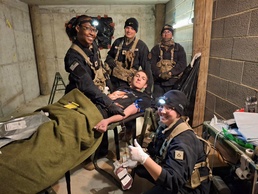
Active Duty and Reserve medics found a creative solution to provide medical care to patients while dealing with threats from above during Combined Resolve 26-07. The threat the medics faced during the exercise was that of Unmanned Aerial Systems, commonly known as drone warfare or strikes. The solution was to take patient care underground. “Our primary objective for this training exercise was to establish and utilize a subterranean role one battalion aid station in order to effectively treat patients underground to counter Unmanned Aerial Systems surveillance and maintain presence on the battlefield,” Capt. Mark Crawford, the physician assistant with 1st Battalion, 4th Infantry Regiment, explained. Crawford said this was the first time the battalion had run an aid station beneath the ground. He explained his medics used an abandoned church and tunnel system present on the training area for the mission. Members of three detachments from the U.S. Army Reserve from Florida – the 369th, 345th and 349th Medical Detachments from Jacksonville, Florida, and the 331st Minimal Care Detachment from Miami, Florida – supplemented Crawford’s medical team during the innovative underground mission. “It was really good getting to work with active duty personnel,” Spc. Andres Ramirez, a medic with the 349th Medical Detachment from Jacksonville, Florida, said. “They do this all the time, while we have different jobs on the civilian side. We mostly provide outpatient or in care in the hospital in a non-tactical environment, while here we can complement them and they can teach us how to adapt to the tactical environment.” Crawford said the skills of Soldiers like Ramirez, who is a clinic coordinator and an emergency medical technician instructor on the civilian side, were very beneficial during the exercise. “It was absolutely great to have them with us because unlike active duty personnel, they have a lot of civilian experience that they bring to us,” Crawford said. “We can actually look at some of the situations and injuries from more of a prolonged field care perspective rather than a tactical perspective because they have a lot of expertise in hospital care and things like that.” The medics used a two-sked loading device system to transport casualties through the tunnel systems. The top sked contained the secured patient, while the bottom sked eased in dragging the casualties through the tunnel pavement. Even with two skeds, Crawford said the mission had its challenges, including choke points within the tunnels, cold temperatures, and the challenge of maintaining light discipline while being careful to avoid injuries to the casualties or members of the medical team during transport. “It was cold, it was dusty, and I made sure to conduct periodic checks on all my medics to minimize the risk of getting ill through ailments like common colds or upper respiratory infections from the dust,” Crawford said. “All of those risks are really amped up when you’re working in a confined space because you’re all breathing the same air and sharing the same space, spreading the same germs. You’ve got to stay on top of that because if doc gets sick how can he or she best effect or help a combat Soldier? The medics needed to also take care of themselves first for that reason.” Sgt. Madeline Fajardo, a medic with 1st Bn., 4th Inf. Regt., explained why training underground was an especially important part of the exercise. “Reacting quickly and doing things that are out of the ordinary is important for medics in exercises like this because you know what you’re going to get hit with, anything can change, at any moment,” said Fajardo. “Especially right now with drone warfare being one of the highest threats we face, we have to be able to adapt to the environment.” The 1st Bn., 4th Inf. Regt. and Reserve medics completed a dual mission during exercise Combined Resolve 26-07. They acted as members of the Opposing Forces team tasked with deterring the maneuvers of the 3rd Armored Brigade Combat Team, 1st Cavalry Division, but also treating real-world incidents of Soldiers who sustained minor real-world injuries during the training. “Success in this mission came down to: were we able to effectively transport the patient, were we able to effectively treat the patient and were we effectively able to get the patient evacuated out of the scenario so that they could get the long-term care they would actually need?” Crawford said. “I believe we actually overcame the vast majority of what they thought we would be faced with.”