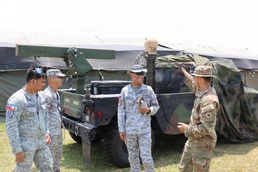
NAVAL STATION LEOVIGILDO GANTIOQUI, Philippines – The U.S. Army, alongside Philippine and Japanese partners, recently conducted multiple defensive live- and dry-fire exercises that centered around Counter-Unmanned Aircraft Systems weaponry during this year’s Balikatan 2026.
U.S. Army soldiers from the 1st Battalion, 51st Air Defense Artillery Regiment and 6th Battalion, 52nd Air Defense Artillery Regiment, alongside U.S. Marines from the 3rd Littoral Anti-Air Battalion and the 12th Littoral Anti-Air Battalion, stood shoulder-to-shoulder with both the Philippine Air Force and Japanese Air Self-Defense Force to demonstrate and exchange knowledge of weapon systems during a combined joint Integrated Air and Missile Defense live-fire exercise at Naval Station Leovigildo Gantioqui, April 26-29.
During the event, 1-51 ADA soldiers conducted C-UAS demonstrations of multiple protection capabilities, including the L3 Harris Vehicle-Agnostic Modular Palletized ISR Rocket Equipment or VAMPIRE, the Integrated Fire Protection Capability, and the Fixed Site-Low, Slow, Small Unmanned Aerial System Integrated Defeat System, or FS-LIDS. These systems enhanced interoperability of Philippine-U.S. air and missile defense operations.
“This exercise demonstrates the role of landpower in a joint and combined fight,” said U.S. Army Lt. Col. Kenneth Collins, commander of 1st Battalion, 51st Air Defense Artillery Regiment. “By bringing rapid, palletized capabilities like VAMPIRE to the shorelines, we provide a decisive, precision-strike capability against small UAS threats, filling a vital role in the air defense network.”
VAMPIRE is a palletized, self-contained precision guided weapons platform designed primarily for counter–small UAS (CsUAS) and for precision strikes against surface targets. The system can carry a payload of four 70mm laser-guided rockets with a proximity fuze that improves lethality against aerial targets.
In addition to the VAMPIRE training, 1-51 ADA used this event to enhance communications efforts within the command-and-control node with the IFPC. This system is a mobile, ground-based weapon system designed to defeat cruise missiles, UAS, rotary-wing, and fixed-wing threats by employing the AIM-9X Sidewinder missile in a surface-to-air capacity.
FS-LIDS is another counter-UAS capability with an extensive operational history. It facilitates the sensing, tracking, and disabling of UAS while providing operators of other C-UAS systems with positive target identification through its electro-optical infrared camera.
These systems are designed to operate in tandem, creating a layered defense of both kinetic and non-kinetic effects to neutralize a range of threats.
“This continuous experimentation with FS-LIDS and VAMPIRE demonstrates the unit's ability to successfully identify and defeat evolving threats,” said U.S. Army Capt. Melanie Rigoni, commander of Bravo Battery, 1-51 ADA. “It ensures that multi-domain formations provide the joint and allied force with cutting-edge protection capabilities.”
Bravo Battery has been working alongside both the Armed Forces of the Philippines and the Japan Self-Defense Forces throughout the process, conducting foundational training activities on C-UAS systems.
“Working with the AFP throughout this exercise demonstrates the ironclad commitment of the U.S. and its Indo-Pacific allies, marking a historic milestone for the first year with JSDF participation,” said Rigoni, “This exercise aides in projecting a unified force capable of deterring aggression and maintaining regional stability.”
As a theater enabling command and a joint force enabler, 7th Infantry Division/Multi-Domain Command-Pacific plays a vital role in providing cross-domain solutions for the Joint Force designed to create multiple dilemmas and neutralize adversary anti-access and area denial networks.
Balikatan is a longstanding annual exercise between the Armed Forces of the Philippines and U.S. military that represents the strength of our alliance, improves our capable combined force, and demonstrates our commitment to regional peace and prosperity.