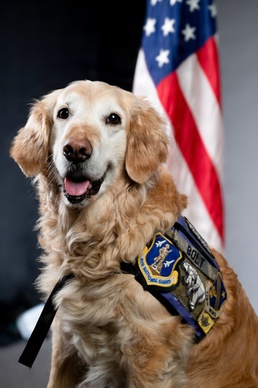
EIELSON AIR FORCE BASE, Alaska – At the Alaska Air National Guard’s 168th Wing, Airmen are used to seeing aircraft, equipment, and uniforms that signal readiness. But one of the most important members of the team walks on four paws, wears a vest instead of a flight suit, and greets everyone with a tail wag brightening even the darkest Fairbanks morning.
Bolt, a Golden Retriever and the official therapy dog of the Alaska Air National Guard and 168th Wing, has become a familiar and welcome presence across the unit. His mission is simple but powerful. He supports the emotional well‑being of Airmen and strengthens the sense of community within the Wing. Bolt’s mission is to support, comfort, and brighten the day of every Airman he meets.
From boosting morale to making his rounds for treats, Bolt keeps the 168th Wing smiling. He’s known for popping into offices, checking the trash for “snacks,” and collecting treats from Col. Benjamin Doyle, the wing commander, and friends across the Wing.
Traveling throughout the state, Bolt supports both the 176th and 168th Wings and members based at Clear in the Alaska Air National Guard and has served for over nine years.
Bolt is a highly trained, nationally certified therapy dog who works closely with his handler, Alaska Air National Guard’s Psychological Health Program Manager, Diann Richardson, a licensed clinical social worker.
“A therapy dog like Bolt is a very well-trained dog that knows basic commands, is friendly, patient, confident, gentle, and comfortable in many different situations,” Richardson said. “Additionally, he provides comfort and love to others, can interact with a variety of people, is not aggressive, and listens.”
She said Bolt arrived in Alaska fully trained with 20 critical voice commands and four hand signals. His training is comprehensive and is a crucial component of his value to the wings.
The origin of how Bolt became the AKANG’s therapy dog traces back to Diann’s daughter, Ruthie. At the time, her fifth-grade daughter was campaigning hard for a second dog, writing persuasive essays for school, and slipping hints into Mother’s Day cards. She continued to find ways to ask, and, with her brother, she made a thoroughly researched PowerPoint presentation explaining why her mom needed a therapy dog at work.
What she didn’t know, Richardson said, was that the timing was perfect. Two Directors of Psychological Health in the Lower 48 had therapy dogs that were making a real difference with their Airmen, and after talking with them, it felt like it was the right move to obtain a trained dog. Bolt came into their lives through an easy application process for a fully trained therapy dog. Within 12 hours of requesting one, Richardson was awarded a dog, and everything fell into place. Another amazing aspect of acquiring Bolt was that he cost nothing. He was a gift from the organization.
Professionals at Southeastern Guide Dogs in Palmetto, Florida, raised Bolt from a newborn pup to 10 weeks, giving him the socialization and training he needed before having him live and continue to train with a volunteer “puppy raiser” family for a year. He then continued his training as a guide dog for people with vision impairments before trainers realized he was too social, a problem because he constantly wants to stop to ham it up with people and other dogs.
“Bolt is extremely social,” Richardson said. “He likes people. He likes other animals. He likes children. He likes to be in the mix of things.”
Disqualifying him for vision-impaired work, his outgoing nature and canine charm were tailor-made for therapy work. Consequently, trainers worked with Bolt for 16 months before delivering him to Richardson.
Bolt’s days are filled with quiet but meaningful work. He visits offices, break rooms, work centers, and attends meetings and ceremonies across the wing, offering comfort during stressful moments and companionship during long shifts.
“Bolt doesn’t just stay on the second floor in the helping hallway; he travels to the first and third floors and roams as he pleases. He loves flying up on the KC-135 and appreciates the “treat generosity” of so many Airmen,” said Richardson.
Airmen often pause when they see him, sometimes to pet him, sometimes just to smile, and those small moments of connection add up. In a high‑tempo environment where service members carry heavy responsibilities, Bolt provides a chance to breathe.
Bolt’s success didn’t stop at the wing; his presence helped spark interest across other Guard units, impacting the DPH program and creating new opportunities for organizations to partner with therapy-dog programs and bring the same support to their own Airmen.
Since Diann obtained Bolt, she notes that other psychological health professionals in several ANG Wings in the Lower 48 and Alaska have received Therapy Dogs, named Ebony and Kanas from Guide Dogs, Inc., and other sources. “I tell my daughter that through her skills of manipulation to obtain a second dog, thousands of Airmen have benefited all over the country – And I couldn’t be more proud!”
His official U.S. Air Force photo captures him sitting proudly, looking every bit the professional member of the team. But behind the polished portrait look is a dog who knows exactly when someone needs a nudge, a lean, or a soft head resting on their knee. Bolt has an uncanny ability to sense tension and step in with the kind of support only a therapy animal can offer.
He is a symbol of the Wing’s commitment to caring for its people—not just as Airmen, but as human beings.
In a place where the mission never stops, and the stakes are high, Bolt’s presence is more than comforting. It’s essential. He may not fly sorties or maintain aircraft, but he strengthens the Wing in his own way, one wag and one lifted spirit at a time.
Bolt isn’t just a therapy dog. He’s a wingman.