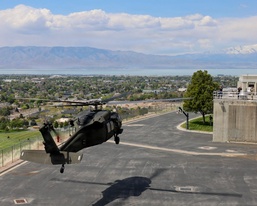
LEHI, Utah – A UH-60 Black Hawk helicopter flew low over the Don A. Christiansen Regional Water Treatment Plant in Orem, Utah, as dignitaries rushed inside to assess the effects of a simulated cyberattack in support of the Utah National Guard’s Exercise Wolverine, April 30, 2026. This large-scale homeland defense exercise focused on disaster response, critical infrastructure protection, and cyber threats, sharpening rapid response and coordination across the state.
One key aspect of the event focused on a realistic scenario where a simulated cyberattack disrupted water purification and distribution at the water treatment plant. This brought together Utah National Guard cyber defense teams, emergency response units, and state partners to rehearse how quickly and effectively they could combat the simulated threat and restore essential services.
This exercise reflects how the Utah National Guard is innovating its training, building partnerships, and showing they are always ready to defend the state against a continuously evolving landscape of cyber warfare.
“The fight in cyberspace is right here in our local communities. It’s in our hospitals, our schools, it’s when we turn on the lights, and every time we take a fresh drink of water,” said Utah Army National Guard Capt. Tyler Jacox, commander of Cyber Protection Team 174, Detachment 3. “Those critical services make up the modern battlefield, and the Utah National Guard is able to be proactive, get ahead of this threat, and maintain these critical services that Utahns depend on.”
Participants worked under strict time constraints, emphasizing critical decision-making and coordination across multiple units. The primary objective was to reduce downtime and restore water services as quickly as possible.
Cyber specialists utilized a Black Hawk helicopter for rapid response and collaborated with onsite engineers and civilian plant operators to rebuild safe operating conditions. Observers evaluated performance in areas such as communication, response time, and technical proficiency.
For personnel working at the water treatment plant, Exercise Wolverine provided an opportunity to work directly with the Utah National Guard cyber teams during a simulated crisis.
“In this scenario, we want to learn what we need to do in case of an attack to make sure all of our facilities are protected, and that the water quality is protected and maintained to our strict standards,” said Brett Taylor, lead operator for the water treatment plant. “We are hoping that we continue to work with the National Guard, continue to make improvements, and hopefully do several trainings to come.”
Taylor further explained how critical the facility is to the community, as they serve the majority of Utah County and parts of Salt Lake County.
The organizers of the exercise noted that while this scenario was simulated, the tactics used were based on real-world cyber threats targeting utilities and municipal services across the globe. Local authorities were informed in advance of the exercise, and officials emphasized that no actual disruption to water services occurred during the training event.
In addition to testing technical response capabilities, Exercise Wolverine aimed to strengthen coordination between military and state agencies. Organizers said that future training events may include broader participation from local partners.
As cyber warfare continues to grow in size and complexity, training exercises, such as Exercise Wolverine, are essential for the Utah National Guard to maintain readiness and resilience, and help the public maintain trust in Utah’s critical utility services.