The Heavy Equipment of Firefighting
Wildland firefighting is a coordinated effort. Like players on a sports team or musicians in an orchestra, hand crews, smokejumpers, water tenders, fire engines, helicopters, airtankers, and heavy equipment all converge on wildfires with two main goals: suppress the flames and do it safely. They all have a part to play.
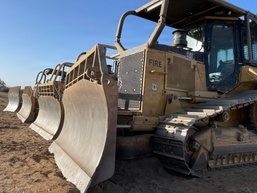
“I'm in a 50,000-pound piece of equipment with a 12-foot metal blade.” That’s Dan Quinn, a heavy equipment operator with the Forest Service. When fighting wildfire he drives a bulldozer.
Quinn has been a heavy fire equipment operator on the Plumas National Forest for the last 10 years. He says he fights wildfires across the country 4 to 5 months out of the year and estimates he’s been to a couple hundred fires during his career.
“We essentially perform the same functions as a hand crew. Just like a hand crew attempts to head off a fire by cutting fire line with their chainsaws and hand tools, we fight fire the same way with the dozer, just faster and on a larger scale.”
Across the country, the Forest Service has about 160 pieces of heavy equipment, including bulldozers and tractor plows, strategically positioned to respond to wildfires. The agency employs about 200 equipment operators just like Quinn.
Bulldozers work in tandem with hand crews and engines to remove vegetation in front of the fire and deprive it of fuel. Bulldozers can often engage safely in situations that hotshots or engines cannot.
“We can withstand a lot more heat from inside the cab of a climate-controlled dozer, with air conditioning and ventilation systems that keep clean air coming in,” said Quinn. “If the flames are a few feet high, it's no big deal.” Standing dead trees from past wildfires, known as snags, are another danger to firefighters on the ground.
“If we need to operate inside old burn scars there's still a lot of standing dead trees, lots of snag patches, it’s not safe for crews to go in there,” said Quinn. “If a small tree were to fall onto the dozer, it wouldn't do much damage. We can withstand that. If that same snag were to fall on or near a person or crew that would cause catastrophic damages, injuries, and fatalities.”
In addition to being efficient, bulldozers are often essential to opening up roads, providing critical access and maintaining infrastructure for wildland firefighters.
“We can usually create and or open up roads to allow engines, crews and equipment to get to where they need to go and to be as productive as possible.”
Quinn said he remembers his early days in wildland firefighting starting off on a hand crew and the feeling when the bulldozer would show up on the fire line.
“It was always a relief when the dozer shows up, it gets a lot of work done very rapidly,” said Quinn, “When you're out there on a crew cutting fire line with a chainsaw or a hand tool and the dozer comes you're pretty happy about it, everyone is pretty relieved.”
Though the bulldozer is a fairly versatile, efficient piece of wildland firefighting equipment, it isn’t always the appropriate tool for the job.
“We want to do the job, contain the fire, but at the same time, we want to do as limited damage to the landscape as possible,” Quinn explained.
That’s why heavy equipment and bulldozer operators work side by side with Tribes, archeologists, hydrologists, botanists, and other trained specialists to understand just how their equipment affects the landscape. After the fire, they help repair and restore the land.
“In the end we go back, and we repair to return those areas, as much as possible, to how they were before,” said Quinn.
Heavy Equipment of Land Management
Even before a wildfire starts, heavy equipment operators work year-round to lower wildfire risk to rural communities, building fuel breaks and implementing forest thinning projects.
In California alone, 70 full-time heavy equipment operators have helped reduce hazardous fuels across nearly 130,000 acres this year. James Crawford operates heavy equipment like masticators, excavators and skid steers on the Los Padres National Forest.
One example is the 2,000 acre Cuddy Valley project in the San Emigdio Mountains. The project was designed to support forest health and to create defensible space for the nearby community of Frazier Park, home to approximately 5,000 residents. The Forest Service and partners are aiming to thin the surrounding dense forest by eliminating certain species of vegetation like pinyon and white fir.
“We're eradicating some of these species in here because they reproduce faster than the surrounding Jeffrey pine and compete for resources like sunlight and water,” Crawford explained. “These species, and others like scrub oak and sage brush, also make the forest denser and serve as ladder fuel for future fires, allowing a wildfire to move from the forest floor up into the canopy more easily.
Crown fires, those burning in the treetops, are notorious for their dangerous and hard to control behavior. They burn hot, causing more damage to ecosystems and posing greater threat to nearby communities.
A few factors make implementing a project like this tricky, said Crawford. Unlike traditional timber harvests, the material that needs to be removed is small and not as commercially valuable. Nor are there nearby mills. Prescribed fire isn’t always an option either.
“There are limitations to using prescribed fire here because of the proximity to the community,” said Crawford, “There's a lot of people that could be affected by the smoke, and prescribed fire also requires the appropriate conditions in order to be conducted safely.”
That makes mastication, grinding vegetation and distributing it on the forest floor, most suitable for this project. Although usually more expensive than prescribed burning, mastication is a reasonable cost alternative when logistics or risk make burning difficult.
“The Forest Service heavy equipment program, it's a great program. We've been doing these defensible space, community defense zones for the better part of two decades,” said Crawford, “We've recently been afforded the opportunity to expand the fuels program using these heavy machines to get the work done.” To learn more about the Forest Services’ wildfire readiness and response visit https://www.fs.usda.gov/about-agency/priorities/wildfire-readiness-response.