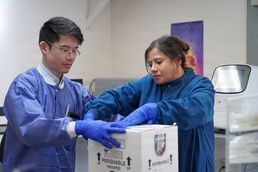
SAN DIEGO– The Naval Health Research Center (NHRC) provided its lab facilities and personnel to support a NASA study from the Artemis II mission on April 11, 2026.
Following the splashdown and recovery of the Orion spacecraft on April 10, a team of NASA, Harvard and Space Tango scientists and engineers met its naval recovery vessel, the amphibious transport dock ship USS John P. Murtha (LPD 26), to secure the Orion payload and bring it to NHRC labs to begin analysis of the A Virtual Astronaut Tissue Analog Response (AVATAR) investigation. AVATAR used organ-chip technology to study bone marrow during the journey around the Moon.
The organ-chips were made using cells taken from the astronauts to develop personalized AVATARs. Science will help NASA understand the effects of deep space radiation and microgravity on human health in space and on Earth.
This study uses miniature, self-contained systems housing living human cells to mimic the function of human organs. The experiment, which flew with the Artemis II crew, is designed to provide crucial data on how deep space radiation and microgravity affect human health.
The research, a key part of NASA’s strategy to "know before we go" farther into space, has as its ultimate goal protecting astronaut health on long-duration missions to the Moon and Mars. The insights gained could lead to the development of personalized medical treatments for future astronauts and improve health protection on Earth.
NHRC staff worked closely with NASA and the Space Tango team to ensure all equipment and lab facilities were ready before Artemis II splashdown. Timing would be critical, from retrieving the payload from the Orion spacecraft to extracting and analyzing the avatar cells.
NHRC's involvement leverages its capabilities in operational health personnel, lab facilities and strategic location.
“Our collaboration with NHRC exceeded expectations,” said Lisa Carnell, director of NASA’s Biological and Physical Sciences Division. “From early planning through on-the-ground execution, the team’s expertise and laboratory support ensured a seamless operation. NHRC continues to be an invaluable partner to NASA.”
The AVATAR investigation is a multi-agency collaboration led by NASA with support from the Biomedical Advanced Research and Development Authority (BARDA), the National Center for Advancing Translational Sciences (NCATS), the Wyss Institute at Harvard University, and commercial partners, including Space Tango and Emulate, Inc.
“The analysis of the AVATAR experiment aligns directly with our core capabilities,” remarked Capt. Kellie L. McMullen, NHRC commanding officer, “as understanding the body's response to extreme environments like space can inform how to protect U.S. service members in unique and demanding operational settings on Earth.”
NHRC, part of Navy Medicine Research & Development, supports Navy, Marine Corps and joint U.S. warfighter readiness and lethality with research and development that delivers high-value, high-impact solutions to the health challenges U.S. military population faces on the battlefield, at-sea, home and abroad.