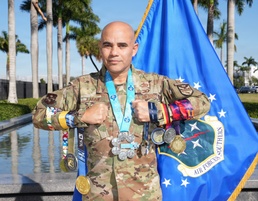
Six days after crossing the finish line in Boston, one U.S. Air Force colonel laced up again and ran the London Marathon.
Still sore and fatigued, U.S. Air Force Col. Alfredo "Juny" Laboy knew quitting was not an option, because he was too close to completing his goal of becoming the only active-duty service member to complete all seven World Marathon Majors within a single calendar year.
According to Abbott World Marathon Majors data, he is also among just 44 athletes worldwide to accomplish this milestone for the first time within a single year. The World Marathon Majors are considered the pinnacle of endurance racing and consist of six premier marathons hosted across the globe.
In 2025, Sydney was added as the seventh major, requiring Laboy to incorporate a new benchmark, along with additional travel, recovery, and preparation within an already compressed timeline.
That back-to-back stretch captured what defined Laboy's entire year, the ability to adapt when the conditions change and remain ready when the mission demands it. Throughout 2025, Laboy, 54, ran marathons in Tokyo, Boston, London, Sydney, Berlin, Chicago, Arlington, and New York City, all while serving as the Air Forces Southern liaison officer to the U.S. Southern Command.
"I was driven by a combination of curiosity and purpose," Laboy said. "After completing marathons on all seven continents, I asked myself what would truly challenge me next. Completing all seven World Marathon Majors in one year wasn't about chasing a medal, it was about testing discipline, consistency, and resilience, the same traits the Air Force has demanded of me throughout my career."
For Laboy, the pursuit was inseparable from his identity as a service member, woven together through physical, mental, and professional readiness; the thread linking the racecourse to the operations center.
"Understanding what the achievement represented made it feel bigger than a personal milestone," he said. "Becoming the only active-duty service member to earn the Six-Star medal and complete all seven World Marathon Majors in a single year carried a strong sense of pride and responsibility.
"This accomplishment allowed me to represent the United States Air Force and my hometown in Humacao, Puerto Rico, while also showing that being over 50 is not a limitation," Laboy said. "You can pursue excellence in fitness and set meaningful goals at any stage of life."
That readiness was tested repeatedly. Among the seven races, the Boston-to-London sequence required Laboy to compress recovery, recalibrate his physical expectations and execute without the preparation most elite runners consider a minimum standard.
"The London Marathon was the most challenging because I ran it just six days after completing the Boston Marathon," he said. "Physically, my body was still fatigued, and mentally, it took every ounce of focus and determination to push through with almost no recovery time."
The effort mirrored another demanding stretch later in the year, when he completed the Marine Corps Marathon, followed by the New York City Marathon just one week later. Sustaining that output alongside a full-time operational workload required the same kind of structured adaptability Laboy applies to planning missions.
"Balancing training with my role required flexibility," Laboy said. "Most runs happened during the workday, fitting them in between meetings, when possible, while weekends were reserved for longer distances. That structure allowed me to stay consistent without stepping away from my operational responsibilities."
This approach also supported the Secretary of War’s military fitness guidance, which emphasizes physical training as a daily duty requirement for service members. He approached physical performance and professional execution with the same framework.
"I treated training like operations — plan, execute, assess, and adjust," he said. "Consistency mattered more than intensity, and everything had to complement the mission, not compete with it."
Adaptability was not optional but a defining trait. Midway through the year, Laboy was diagnosed with an umbilical hernia, a development that would have ended the pursuit for most. Instead of quitting he persevered, working under strict medical guidance, he restructured his approach and pressed forward.
"There were moments of doubt, especially after I was diagnosed with an umbilical hernia following the London Marathon," Laboy said. "Under strict medical guidance, I was able to delay surgery and complete the remaining races safely."
Laboy also managed pre-existing conditions throughout the year, including bilateral hip bursitis, plantar fasciitis and vestibular neuritis, a condition that affects balance. Each of these conditions required ongoing adjustments to keep him mission-capable on and off the course.
"Following medical guidance and adjusting expectations allowed me to keep moving forward without missing a single day of work due to running-related injuries," he said.
Laboy said, overcoming these obstacles further reinforces that the parallels between endurance sport and military leadership are direct, not metaphorical.
"There are no shortcuts,” he said. “Both require preparation, accountability, adaptability, and the ability to lead yourself before leading others."
Lt. Gen. Evan Pettus, deputy commander of U.S. Southern Command, said Laboy's accomplishment is a model of the readiness and adaptability the command requires of its leaders.
"I’ve had the opportunity to follow and talk with Juny throughout this journey, and what stands out isn’t just the mileage -- it’s the discipline behind it,” Pettus said. “He never let a demanding schedule or personal setbacks distract him from the mission. He trained around his responsibilities, not the other way around. That balance and commitment to excellence while remaining fully engaged in the fight reflects the steady resilience and adaptability we expect from our leaders."
Laboy said the year reinforced that readiness is not a product of youth, but of discipline sustained over time. "Readiness isn't limited by age but it's sustained by mindset," he said. "Resilience is built over time through discipline, physical fitness, and mental toughness. When Airmen take care of themselves, they're better prepared to take care of the mission."
Standing at the finish line of his final race, Laboy said gratitude outweighed his exhaustion.
I felt gratitude for my health, my mother, my kids, and everyone who supported the journey," he said. "I also felt excitement for what comes next and the goals still ahead."
Earlier this year, Laboy completed the Coast Guard Marathon in April and the Cape Town Marathon in May, bringing him one step closer to a rare milestone in the Abbott World Marathon Majors series. With the Cape Town race currently under provisional status pending final evaluation, Laboy is on track to earn recognition for completing eight major marathons. But for Laboy, the finish line keeps moving forward. He is now preparing for the Air Force Marathon in September and the Army Ten-Miler in October as part of the Armed Forces Series Challenge. Beyond that, he hopes to position himself among the first athletes eligible for the future Nine Star Medal, expected to launch in 2027 pending Shanghai Marathon’s formal acceptance as the ninth World Marathon Major.