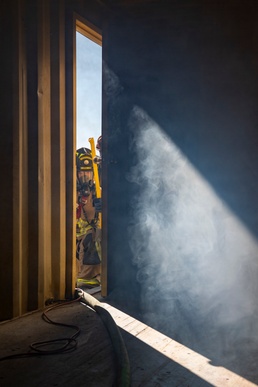
DOBBINS AIR RESERVE BASE, GA -- From April 6-10, 2026, Dobbins Air Reserve Base acted as host to some of the most intense firefighter rescue and survival training the Department of War has to offer.
“The Firefighter Rescue and Survival course here at Dobbins has taken my understanding of fire rescue and survivability to a new limit,” said Jeremy Johnston, 134th Air Refueling Wing station captain. “The class and the instructors have done an amazing job at pushing us to the limit and really getting us thinking about how we need to prepare ourselves prior to arriving on scene. They really do a good job of making you think of the downed firefighter in the way that, ‘that's your brother and you need to get them out.’ The class physically pushed me past a point in a way that I did not think firefighting could get pushed – air consumption, rescue tactics and rapid intervention crew training – it's the best that I've ever had.”
The FRAS course is a five-day, 50 hour class that pushes DoW firefighters to their limits and builds resiliency and muscle memory through stress inoculation by performing high-risk, low-frequency training scenarios. The training uses a crawl-walk-run framework, whereby students will spend more than 90% of each day in full personal protective equipment, completing a variety of job-specific, critical training requirements in succession. Students perform tasks like rappelling out of windows, combative downed firefighter with a ladder bailout rescue and carrying another firefighter up flights of stairs in full gear with a self-contained breathing apparatus. The environment is demanding, but supportive and helps remind students and instructors alike that during their training, firefighters are given “No Slack” as they prepare for the physical and mental stressors of environments they may face during conflict.
“The term ‘No Slack’ stems from a guy named Col. David Hackworth, a kind of legendary Army officer who took command of the 4-39 [Infantry Regiment] in Vietnam,” said Senior Master Sgt. Chris Bauchle, 434th Air Reserve Base deputy fire chief. “It's a story we tell the students on day one. The 4-39th had a horrendous reputation, morale was horrible and they were sustaining some of the highest casualty rates in all of Vietnam, predominantly from friendly fire and booby-traps. [Hackworth] recognized pretty quickly that it was little things that were getting his guys killed. They weren't wearing camouflage on missions and they weren't taking care of their weapons or their feet, so one of the first things he did was reinstitute the tradition of saluting, and when an enlisted man would report to an officer, they would say, ‘hardcore recondo, sir,’ to which the officer would reply with ‘No Slack!’ He wanted that to be a reminder that the little things matter.”
Instructors and senior leaders within the firefighting career field have built this history into the development of the FRAS course. Each skill and drill tested and trained throughout the course is tied to a near miss or to the death of a firefighter in the line of duty, largely caused by mishaps that could have been prevented.
Within firefighting, tragedy occurs when an accumulation of small issues compile over time to create line-of-duty deaths or near misses. According to the U.S. Fire Administration, in 2024, 72 firefighters died while on duty, 26 died from activities related to operating at a fire scene, 16 died from activities related to operating at a non-fire scene and 8 died while responding to or returning from emergency incidents.
“There's no fire service line-of-duty death that starts with ‘everything went perfectly until this one catastrophic thing happened,’” Bauchle said. “That's something we try to instill in the students from day one when they come here.”
During the FRAS course, students aim to earn the No Slack patch. Students are given frequent opportunities to lead and make decisions under adverse and dynamic conditions, while being given inadequate or incomplete information about the scenarios they are encountering. Students and instructors must adhere to strict preparation, such as proper hydration and nutrition, safety procedures and physical and mental health awareness, both before and during the course. Following the end of the course, students who complete every single skill and drill presented to them, proving that they can and will uphold the No Slack standard, will be awarded the patch. The patch is a badge of honor for those who complete the training, representing their discipline, skill and the desire, ability and courage to perform tasks safely, accurately and effectively while under extreme pressure.
“Coming here, firefighters should expect to be challenged,” Bauchle said. “This is not your normal course. The things that we are doing here are not normal for anybody and we're stringing skills and drills back-to-back, day after day. There's this cumulative effect where it becomes just as psychological as it is physical. Students that come here should want to be challenged physically and psychologically, and they should want to test their decision-making and leadership skills.
The FRAS course sets an uncompromising standard, creating an environment where students can safely fail, learn and rapidly progress to an elite level over five days. Unlike many programs, the standard is never lowered because in real-world, high-risk events, there are no second chances and the expectation is simple: meet the standard or don’t.
With many of the participants in the course being Reserve Airmen, they bring an added layer of expertise to the fight. These Airmen provide a force advantage by combining their military excellence with civilian-sector innovation and expertise.
“Training for me here at Dobbins Air Reserve Base in the FRAS course has been the hardest I've ever been pushed physically in the Air Force–probably in my entire life,” said Staff Sgt. Jesse Pueschel, 812th Civil Engineer Squadron driver/operator. “Some of the things that we are doing here require you to use specific techniques, and even when you use the proper techniques you might have to end up recapturing some progress, and you'll just get drained. Time and time again, there were points where I was doing an exercise and they would tell us, ‘come on, let's pick it up and keep it going,’ and it really instilled that sense of urgency.”
The FRAS course is the most demanding training a DoW firefighter can face, built to develop the resilience, adaptability and warrior mindset required for unpredictable, high-risk deployment environments. By pushing Airmen through the hardest scenarios in the profession, the course builds firefighters who are mentally and physically prepared to accomplish the mission no matter the conditions.
“On deployment, so much of our focus is resiliency, adaptability and warrior ethos, and by having firefighters do the hardest stuff we could possibly do in our profession here, that's how we build all those qualities that we're going to need in the next battle space where a lot of us don't have a real mental picture for what that's going to look like,” Bauchle said. “We're talking about island hopping and small teams, and we're war-gaming trying to figure out how to be successful. But if you've got a group that comes in with the mindset of ‘we can do anything, we're unstoppable, we'll run through a brick wall if we need to,’ the mission's going to get accomplished. On deployment, in warfare, you want firefighters that are wired to perform at that level and are able to figure out whatever needs done.”
At the core of FRAS there are what the instructors call ‘cardinal sins,’ or common mistakes that can prove fatal in the field and are met with instant corrective consequences during training. The ‘cardinal sins’ are derived from the National Institute for Occupational Safety and Health reports. Every line-of-duty death has a NIOSH report, and every report has contributing factors that identify what mistakes were made to contribute to the death. These actions can include anything from a firefighter giving the wrong location when calling a mayday, failing to communicate on the correct radio channel or even failing to wear protective gear properly.
“The ‘cardinal sins’ of FRAS are all recurring themes in those [NIOSH] reports. They are all the little things that happen over and over in line-of-duty deaths. Any time a ‘sin’ of slack occurs throughout the course, it's paid for on the spot with 10 push-ups,” Bauchle said. “There are plenty of classes where the count has been well over 700 push-ups in a day, but that's how [the students] remember. It's never a punitive thing, as the instructor is doing them with the student, because we're here learning too. We've made all the mistakes the students make throughout the week.”
Ultimately, firefighting is a demanding career that requires Airmen be prepared for the type of worst-case scenarios that training like FRAS throws at them. While they may rarely, if ever, encounter such extreme circumstances at their home stations, their ability to execute seamlessly under pressure remains critical. The course perfectly captures the Air Force Reserve’s warrior culture that standards are non-negotiable and Airmen train exactly as they fight. By combining rigorous military experience with their everyday civilian sector expertise, the Reservists participating in the training bring a unique depth of experience to the table and help ensure the Air Force has the specialized skills it needs ready to surge when it matters most.
“For my job as a fire protection specialist at Edwards Air Force Base, this course does not compare in terms of our day-to-day; however, it does prepare us in terms of the worst-case scenario,” Peuschel said. “Worst-case-scenario being that we're on scene and we have to rescue one of our brothers or sisters. That is something we don't ever want to have to do, but we have to prepare for it.”
After completing the course, the instructors aim for the students to go back to their stations to be a positive force within their units and share their training experience. Students are encouraged to transfer their newfound skills and experience back to others at their home units.
“The students can play such an instrumental role in making sure that the other firefighters they work with are prepared for whatever they might be called to respond to, and they can do that by bringing some of these skills and drills back, being the one to tee up training and bringing the best practices they learn here to the firefighters that didn't attend the course,” Bauchle said. “We talk to them about how they do that by initiating a group workout – we believe when a group in the military works out together they're going to perform that much better in whatever their job is – all the way to never gossiping, never being part of the problem, always working to be a positive force and to make their fire department and the firefighters they work with just slightly better every single day.”
After a decade of conducting the FRAS course, Bauchle’s goal is to expand the ripple effect by continuing to prioritize joint, hands-on training that builds real resilience rather than checking a box.
“My hope is that the ripple effect just continues to grow. We’ve got an Air Force lead and a Marine Corps lead, and our hope is that military leadership continues to prioritize joint training,” Bauchle said. “This isn't a certification course. The firefighters either leave here with the patch or they don’t. We're going after all the things that need to happen to make firefighters resilient, to stress-inoculate them and to prepare them. It’s training that has to be done the hard way.”
Department of War firefighters can sign up for FRAS at http://dodfras.com/, where all four annual classes are posted, with additional options to join a distribution list for future course notifications. Dobbins ARB and Camp Lejeune both host one class each spring and one class each fall.