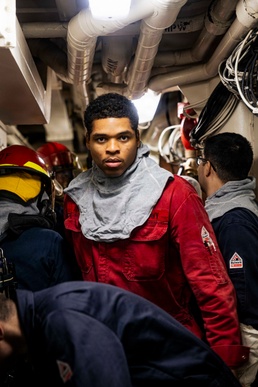
Don’t give up the ship — This phrase echoes through Sailors minds as they render aid to simulated casualties aboard USS Iwo Jima. As they breathe, the pressurized air hisses from a self-contained breathing apparatus. A bright red helmet and thick fireproof fabric comprise their standard firefighting ensemble, forming a protective cocoon, which shields the Sailors from intense heat. Heavy thuds are heard as their rubber boots hit the deck as they move forward toward a looming danger—a blazing fire.
Once they have arrived at the boundary, Sailors stand poised, ready with a powerful tool in hand—a fire hose. For now, they wait with the hose team for a sign from the team lead to engage the roaring inferno.
On command, Sailors release a precise stream of water from the nozzle toward the base of the flames—choking off heat and oxygen—until the blaze is contained.
This is one of the training scenarios ran during a damage control training evolution aboard Wasp-class amphibious assault ship USS Iwo Jima (LHD 7). Each evolution is meticulously designed to enhance a Sailor’s understanding and reaction to real-world events such as flooding, fire, gas leak, or a hull rupture.
The ship’s damage control personnel are key to preparing Iwo Jima’s crew for mitigated these possibly disastrous events.These Sailors focus on the upkeep of firefighting systems, maintaining damage control lockers, and manning the flying squad—the ship’s at-sea response team. Their primary function, however, is to prepare others to combat casualties.
“As [damage control personnel] we are in charge of knowing how to firefight, control casualties such as flooding, and combat chemical, biological, and radiological hazards,” said Damage Controlman (DC) 1st Class Mark Rangel. “We have to understand how to interpret and control a casualty [while being able to] reciprocate that same information to the crew so they understand that at any point in time [they may need to step up and] be a firefighter.”
Preparing Sailors takes two forms: hands-on evolutions that involve working with the damage control equipment to combat simulated casualties and knowledge-based trainings in a classroom setting.
“We have three [hands-on] drills a week utilizing different lockers to practice skills. There is also the admin side, in which we get [Sailors] qualified to stand positions on the watch bill and train on general knowledge,” said Lt. Rachel Goldkamp, the assistant damage control assistant.
“It’s important to train on damage control, so that when bells ring, we know how to respond,” she added.
A key component of effective and long-lasting training may be as simple as adjusting the mindsets of the crew.
“If you show up and you're not motivated to learn, what's the point in being there at all if you're not receptive to any of the training that is being given,” said Goldkamp. “If you are motivated and you go hands on, you're going to learn a lot more than if you're just standing around watching.”
Damage controlmen try to bring an exuberant amount of energy to the trainings to attempt to help motivate the rest of the crew to get the most out of the training.
“The biggest thing is to have our damage control training team being super hype, and being able to give that energy [to the crew],” said Rangel. “So, when they are drilling, [Sailors] will receive that energy and give it back to [the training team] times two. The more people are motivated the easier it is to push through [a casualty].”
Another challenge faced by DCs is balancing training times and agendas. To combat schedule conflicts, the damage control team create a flexible training cycle, which flows throughout the week.
“I know it's difficult for [Sailors] to get to the some of the trainings that we put on,” said Goldkamp, who added that training flexibility is imperative because of the operational commitments that drive the ship’s schedule.
Aboard a ship like Iwo Jima, no two casualties will be the exact same; however, the methods to fight them may be similar. Sailors are directed by DCs to perform a variety of hands-on scenarios while underway to help them respond to dynamic situations. These scenarios can include fires, flooding, toxic gas or hazardous waste spills, hull ruptures, and mass casualty events.
“It's important for everyone to respond to all of the drills that we do throughout the week,” said Goldkamp. “This is so [the crew] can actually get hands-on practice setting up, scoring, pipe-patching, using hose handling techniques, and things like that.”
Damage control evolutions are designed to instill the ‘Don’t Give Up the Ship’ mindset. This phrase is the hallowed motto of the Navy’s damage control programs and serves as a rallying cry for Sailors fighting casualties that can threaten the very vessels they live and work on.
“[This mantra means] always trying to find different ways to combat, minimize, or completely put out a casualty. If we’re able to maintain the casualty in one specific area, one compartment and put it out, then that’s [how] we keep the ship afloat,” said Rangel.
Goldkamp has assessed the overall effectiveness of the damage control training, and the crew is in a good spot and has made strides in overall readiness.. Both Goldkamp and Rangel believe Iwo Jima’s Sailors are more than capable of fighting any casualty, which may occur.
“Going into deployment, we had a pretty young crew [and] it has been kind of a learning curve, but I think we have definitely come a long way,” said Goldkamp. “I think that there is always room for improvement.
“We are still learning something new and getting more and more proficient every single week.”