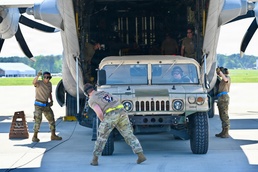
DOBBINS AIR RESERVE BASE, Ga. – Airmen from the 419th Fighter Wing’s 67th Aerial Port Squadron demonstrated technical expertise, adaptability, and teamwork during the 2026 Air Force Reserve Port Dawg Challenge, April 14–16, representing Hill Air Force Base and the northern Utah community on a national stage.
Competing as a six-member team against 25 other Air Force Reserve Command units and international partners, the 67th APS executed 12 events designed to test real-world air transportation skills, from cargo and passenger processing to equipment operations and physical endurance. The team also continued its legacy of excellence in the competition’s physically demanding Fit to Fight event, earning another first-place finish for the seventh consecutive time.
The annual competition, held at the Transportation Proficiency Center, emphasizes readiness by placing Airmen in dynamic scenarios that mirror deployed environments, often removing modern systems to stress foundational knowledge and adaptability.
“For some of these events, we prepared for electronic versions, but they gave us paper copies,” said Tech. Sgt. Richard Schaefer, a cargo journeyman with the 67th APS. “If certain systems go down, there’s a pretty good chance you’re going to be using paper copies and we need to know how to do that in order to get the job done.”
That focus on contingency operations carried across multiple events. During passenger processing and Air Terminal Operations Center scenarios, Airmen manually verified eligibility, tracked cargo and documented aircraft loads without digital tools, replicating austere conditions where systems may be unavailable.
“Anytime we go from familiarity with computer access to hand-jamming is a challenge,” said Tech. Sgt. Drew Fandsen, who competed in the ATOC event. “There’s always a time where you may not have access, so the mission has to go forward regardless.”
For Master Sgt. Logan Terry, the team chief and a load planning supervisor, the competition provided a comprehensive test of the squadron’s core mission.
“Passenger processing is essentially manifesting people and getting them to the aircraft,” Terry said. “It’s about making sure everything flows the way it should.”
That flow, whether moving passengers or cargo, defines the aerial port mission. Air Transportation specialists ensure personnel and equipment move efficiently across the globe, directly supporting combatant commanders and enabling rapid global mobility.
Senior Airman Carlos Palomino, who competed in the pallet build-up event, emphasized the precision required to prepare cargo for flight.
“We have to make sure everything is not shifting, that it’s going to the correct place, and that it meets weight and height limitations,” Palomino said. “People around the world need that cargo, so we optimize everything we can.”
The competition also tested equipment proficiency and teamwork during events like the 10K forklift and 25K Halvorsen loader courses, where communication and coordination were critical to safely maneuver cargo and aircraft assets.
“It’s very similar to real-world missions,” said Senior Airman Faith Collier. “Communication is super important, you have to have spotters, people guiding you and making sure everything is safe around the aircraft.”
Beyond the competitive events, the 67th APS contributed to the success of the challenge by providing multiple umpires, supporting event execution and reinforcing the squadron’s role within the broader air transportation community.
Chief Master Sgt. Brandon Delos Reyes, senior enlisted leader for the 67th APS, said the competition remains a vital tool for building both technical proficiency and esprit de corps across the career field.
“The competition is unlike anything else I’ve ever seen in AFRC,” Delos Reyes said. “It is an outstanding tool for motivation and camaraderie, and a great opportunity for people to network and reconnect with people they’ve worked with for years.”
Leaders also emphasized the importance of mentorship and passing on experience to younger Airmen, a key factor in sustaining readiness across the force.
“It’s extremely important that what we found effective during deployments is still enduring,” Delos Reyes said. “They might not remember you, but they remember what you expected.”
Established in 2010, the Port Dawg Challenge brings together Airmen from across the Total Force and allied nations to sharpen skills, strengthen partnerships and demonstrate air transportation readiness in a competitive environment.
For the 67th APS, the event reinforced the versatility required of today’s Air Transportation specialists, operating in contested, degraded or resource-limited environments while maintaining mission effectiveness.
As Air Force Reserve Command continues to provide nearly half of the Department of the Air Force’s air transportation capability, the performance of units like the 67th APS ensures the force remains ready to project combat power anytime, anywhere.