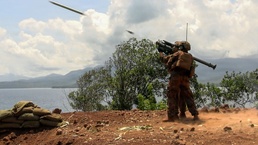
APORAWAN, Philippines – U.S. Marines with Marine Rotational Force – Darwin participated in a combined counter-landing live-fire exercise alongside service members from the Armed Forces of the Philippines, Australia Defence Force and New Zealand Defence Force, April 27, 2026.
In the most expansive Balikatan to date, MRF-D Marines seamlessly integrated with allied and partner forces to showcase coordinated defensive operations to engage and destroy simulated enemy amphibious forces approaching the beach.
“This was great training for the Marines that I’m responsible for as a part of this," said U.S. Marine Corps Col. George Flynn, commanding officer of MRF-D 26. “That interoperability is critical. It just demonstrates what we can do together.”
The combined team kicked off the day’s events with the firing of M142 High Mobility Artillery Rocket Systems engaging moving targets off the coast of Palawan. M252 81 mm mortar and M224 60 mm lightweight mortar systems fired rounds at designated target areas. BGM 71 tube-launched, optically tracked, wire-guided missiles and FGM 148 Javelin missiles engaged as the simulated enemy landing craft approached.
The MRF-D ground combat element, made up of 1st Battalion, 5th Marine Regiment with attached ground combat capabilities, provided suppressive fire across engagement zones from M2 .50-caliber heavy machine guns while their Philippine Marine Corps counterparts added artillery firepower to the coordinated defense, and low-altitude air defense systems countered threats from simulated enemy aircraft. For the first time in the Philippines, the MRF-D GCE fired live payloads with a first-person view drone.
The combined force used the advanced field artillery tactical data system to coordinate fires across the multinational force, ensuring deconfliction and maximum effectiveness.
Through this demonstration, the collective team highlighted the interoperability achieved through combined and joint planning. By synchronizing weapons systems across multiple nations, from individual crew-served weapons to artillery batteries, the exercise showcased the lethality of the U.S., Philippine, Australian and New Zealand combined force during complex defensive operations.
“The integration of these capabilities is the cornerstone of how this is done,” said Flynn. “Just seeing the integration amongst our allies to work the clearance of airspace, the clearance of the maritime domain, and the clearance by fires in the land domain really set the mark for what can be done in defense of the Philippines.”
Balikatan is a longstanding annual exercise between the Armed Forces of the Philippines and U.S. military that represents the strength of our alliance, improves our capable combined force, and demonstrates our commitment to regional peace and prosperity.