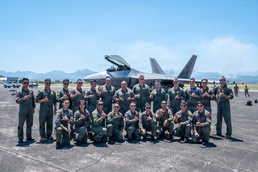
CLARK AIR BASE, Philippines — For more than 90 Airmen from the 199th Air Expeditionary Squadron, Exercise Cope Thunder 26-1, conducted April 6–17, was more than just another deployment, it was an opportunity to strengthen a long-standing partnership while working side by side with Philippine Air Force counterparts in an environment that demanded trust, adaptability and teamwork.
Representing a mix of active-duty and Air National Guard personnel from Joint Base Pearl Harbor-Hickam, the team, known as the “Hawaiian Raptors,” brought fifth-generation F-22 Raptor airpower to the exercise, flying alongside Philippine FA-50PH fighter aircraft.
Over the course of the exercise, the squadron flew more than 30 sorties as part of a combined force of over 2,800 U.S. and Philippine personnel. But the impact of Cope Thunder went far beyond time in the air.
From the moment Airmen arrived, to their final flight, the work extended into planning rooms, maintenance areas and conversations on the flight line, where relationships were built and lessons were shared in real time.
“For the Hawaii Air National Guard, this partnership is especially meaningful. We just celebrated 25 years as state partners with the Philippines and look forward to the next 25 and beyond,” said U.S. Air Force Brig. Gen. Phillip L. Mallory, Hawaii Air National Guard commander. “This is the third time in recent years that Hawaii-based F-22 Raptors have deployed to the Philippines, and each time we continue to grow stronger together.”
Originally established in the Philippines in 1976, Cope Thunder has grown into a cornerstone bilateral exercise. Today, it reflects not only the demands of modern air warfare, but also the importance of working seamlessly with partner nations in complex environments.
That cooperation was evident throughout the mission, including across several subject matter expert exchanges. Through a maintenance-focused exchange, maintainers from both nations shared techniques, compared troubleshooting approaches and gained insight into how each generates aircraft across different platforms and processes.
“Working alongside our Philippine counterparts, we were able to share techniques and really get on the same page, even coming from different aircraft and specialties,” said U.S. Air Force 1st Lt. Kyle Matern, 199th Air Expeditionary Squadron maintenance officer. “At the end of the day, it comes down to trust, knowing we’ve got each other’s back and we’re all working toward the same mission.”
Behind every sortie was a network of support making it possible to keep aircraft flying. During the exercise, U.S. Army forces established expeditionary fuel systems in austere conditions, ensuring operations could continue without interruption—demonstrating how joint teams extend the reach and endurance of the force. In the air, that same sense of trust translated into high-intensity training for pilots.
“I had the privilege to fly with our U.S. counterparts, with one of the best fighter squadrons in the world, the Hawaiian Raptors—and wow, that was the hardest one minute, and 30 seconds of basic fighter maneuvers I performed in my life,” said Philippine Air Force Maj. John Red “Period” Honrales.
“It’s always an honor to fly with our U.S. allies,” Honrales added. “Every sortie flown together is a reminder that freedom is defended not by one nation alone, but by alliances who stand shoulder to shoulder.”
For many involved, the connection between Hawai‘i and the Philippines added another layer of meaning. The two share a 25-year State Partnership Program relationship built on mutual respect, cultural ties and a shared commitment to regional stability—creating a foundation that allows teams to integrate quickly and operate effectively together.
At the center of the Hawaiian Raptors’ contribution was the F-22 Raptor. Flying alongside Philippine FA-50s, both forces trained to communicate clearly, adapt quickly and operate as a cohesive team in dynamic scenarios.
“Integrating the Raptor pushes everyone involved and makes us better every time we fly,” said Lt. Col. Curtis “Narco” Yoshimoto, 199th Air Expeditionary Squadron commander. “What matters most in this exercise is mutual respect, collaboration and the collective effort that drives us toward a shared goal. Working through the process, maintaining open communication at every level, and staying flexible is what allows us to come together and deliver. That’s how we build on success—putting in the work together.”
As the exercise ended, leaders emphasized that success wasn’t defined by any single mission or milestone—but by the people behind it.
“To the planners, leaders, subject-matter experts, maintainers, aircrew, ground personnel, security forces, logistics and medical teams, and every individual working behind the scenes, your contributions may not always be visible, but they are essential,” said Philippine Air Force Brig. Gen. Angelito R. Retuta, wing commander, Tactical Operations Wing Northern Luzon. “Cope Thunder does not succeed because of one group or one leader—it succeeds because of the collective effort of every person.”
“Cope Thunder 26-1 is not just an event,” Retuta added. “It reflects our shared commitment to readiness, interoperability and security. We will continue to build on this as we move forward.”
With more than 2,800 personnel working together, Cope Thunder 26-1 showed that partnerships are built through shared experience, trust and consistent effort, ensuring both nations remain ready to meet future challenges together.