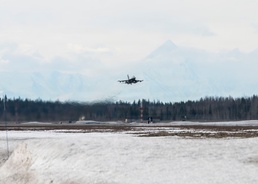
Eielson Air Force Base, Alaska -- RED FLAG-Alaska (RF-A) 26-1 kicked off April 16, 2026, and the 51st Fighter Wing assigned to Osan Air Base in the Republic of Korea, took the helm as the lead wing for this iteration.
RF-A is a set of Pacific Air Forces commander-directed field training exercises for U.S. forces that provides joint offensive counter-air, interdiction, close air support, and large force employment training in a simulated combat environment.
Maj. Nolan Mallory, 36th Fighter Squadron assistant director of operations, is the operations project officer for this iteration, bringing combat ready F-16 aircraft and real-world theater expectance from the Indo-Pacific to the planning process.
“At the scenario design conference each unit would come up with their own desired learning objectives,” Mallory said. “With having smaller formations, there are definitely some learning objectives that we are able to get after that may have been more difficult with larger formations.”
This iteration hosted units from the U.S. Navy and Marines Corps. RF-A integrates joint and coalition forces training in simulated forward operating bases to improve response capabilities across a range of contingencies.
“Integrating with the Navy and Marines has been a pretty awesome experience,” he said. “They’ve got different experiences and perspectives. You can see it in the mission planning. But at the end of the day, we have different ways but are all working toward the same goal.”
Operations during RF-A help units identify training, equipment, and capabilities the Joint Force requires to operate in the Arctic and other challenging environments, while providing firsthand experiences to both pilots and ground crew.
“From the tactical and training side of things, this might be some people’s first time participating in a large force exercise,” Mallory said. “This experience is important. Now whenever they go on another TDY or assignment they have this confidence to fall back on and can keep building on their experiences."
RF-A takes place in the Joint Pacific Alaska Range Complex (JPARC), the Department of War’s largest air space that provides a realistic training environment for large-scale joint engagements. For Capt. Daniel Rollins, a 36th FS F-16 Fighting Falcon pilot, this was his first experience with RF-A and this airspace.
“There has definitely been a lot to learn here,” Rollins said. “A lot of the game planning is at the team lead and mission commander level but even at a lower tactical level, it’s about how what we do on a daily basis during training integrates when we’re working with other platforms.”
RF-A directly supports the Peace though Strength strategy by improving combat readiness and warfighting skills. This training raises the costs of aggression and reinforces a credible deterrence.