FORT BRAGG, N.C.- In complex combat environments, fatality management specialists step forward to honor one of the Army’s most sacred promises: never leave a fallen comrade. 92Ms recover and return fallen service members with unwavering dignity, ensuring no Soldier is ever left behind.
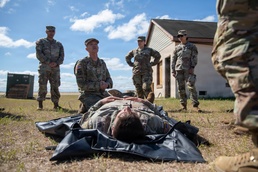
Fatality management specialists from across Fort Bragg came together on April 24 and 27, 2026, to conduct the first Active Duty Unit Recovery Team (URT) training using non-anatomical media (NAM), marking a significant milestone in U.S. Army combat readiness.
The training brought together 92Ms from XVIII Airborne Corps, the 101st Airborne Division (Air Assault) and the 1st Armored Division. Religious affairs teams from across the installation and the 44th Medical Brigade were also crucial to the collaborative effort to strengthen unit-level capabilities during large scale combat operations (LSCO).
“I’ve been operating in fatality management for almost 20 years,” said Sgt. 1st Class Delbert Ruede, the fatality management non-commissioned officer in charge assigned to the 3rd Corps Sustainment Command (CSC). “We know that our ability to bring every Soldier home with dignity depends on how well units are prepared before the worst happens.”
As commanders, the responsibility for fallen personnel within their operational area ultimately rests with them, says Ruede. URT reinforces this duty by preparing Soldiers to recover remains from the front lines and move them safely to the nearest Mortuary Affairs Collection Point (MACP).
Religious affairs specialists, or 56Ms, were among the main individuals attending the training to align with the Chaplain Corps’ mission pillars: nurture the living, care for the wounded and honor the dead. Their growing partnership with fatality management personnel aims to better prepare units to support commanders in their responsibility to recover and honor fallen service members.
“Training religious affairs personnel in URT is essential to our combat readiness as it incorporates the spiritual and mental resiliency that some people overlook when thinking about readiness,” said Spc. Kacie Stewart, a religious affairs specialist assigned to the 96th Civil Affairs Battalion (Airborne), 95th Civil Affairs Brigade, 1st Special Forces Command (Airborne). “Now that we’ve seen what fatality management has to go through, we can help in more ways than one.”
The training began in a classroom environment covering basic mortuary affairs fundamentals, including recovery equipment, clearing procedures, loading remains for transport and the phases of recovery operations.
The hands-on portion included casualty identification and notionally securing remains into human remains pouches. The personnel then moved into a controlled environment where they worked with the 528th Field Hospital’s NAMs.
Stewart said the training allowed Soldiers to experience the physical and mental challenges of handling deceased individuals, which differ from moving live casualties.
The introduction of the NAM’s is a critical component of the training. Ruede says the hands-on repetitions are vital to recovery tasks, the realism provided by the use of the NAM’s allowed for Soldiers to better understand the physical realities of handling human remains. The exposure included conditions such as decomposition, bodily fluids, rigor mortis and other possible conditions that may be encountered during LSCO.
“The fatality management teams aren’t always going to be available at the front lines, they’ll be in the MACPs,” said Ruede. “That is why this training matters, exposing Soldiers to realistic conditions in a controlled environment now will build their understanding and skillset that they’ll rely on when it matters.”
Research from Dr. Amy Adler at the Walter Reed Army Institute of Research found controlled exposure to deceased individuals reduced post-traumatic stress disorder symptoms by more than 50% compared to service members whose first exposure occurred in combat.
Ruede further explains this finding is a vital factor in expanding URT training across the service. With fewer than 400 active-duty 92Ms in the U.S. Army, the need for Soldiers outside of the mortuary occupational speciality is critical to support recovery operations.
“These environments prepare Soldiers not just how to react but to lead through one of the hardest moments of combat,” said Ruede. “Training events such as this one prepares Soldiers for the conditions they will be experiencing long before they face real combat casualties”
This training aims to build the capability for every company to field a five‑person URT, strengthening support for fatality management operations throughout complex environments. Preparing non‑mortuary Soldiers to conduct dignified recovery operations allows the Army to reinforce combat readiness and its commitment to bringing every service member home.
The 3rd CSC plans to expand this training to other occupational specialties in future iterations.
-30-