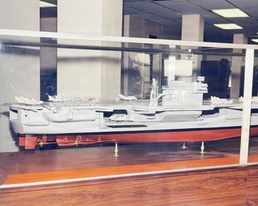
For more than three decades, a model of theUSS Constellation (CV-64)has been on display atFleet Readiness Center Southwest(FRCSW) but this ship is more than just a model as it embodies the evolution of three U.S. Navy aircraft carriers and reflects the critical role FRCSW has played in their support.
Commissioned on October 27, 1961, USS Constellation was one of the Navy’s most capable aircraft carriers of her time. Her keel was laid on September 14, 1957, and she was launched on October 8, 1960, marking the culmination of years of engineering and shipbuilding innovation.
At 1,079 feet long with a 252-foot-wide flight deck spanning 4.5 acres, Constellation was a floating city and airbase combined. Powered by four steam turbines generating 280,000 horsepower and driving four propellers, she could reach speeds of up to 35 knots. Designed to carry approximately 85 aircraft, the ship supported a crew of over 5,600 personnel, including enlisted sailors and officers. Homeported inSan Diego, “Connie” became a cornerstone of U.S. naval operations in the Pacific.
The model in FRCSW’s care is far more than a replica, it is a historical artifact that traces its lineage through three aircraft carriers: USS Saratoga (CV-60), USS Independence (CV-62), and finally USS Constellation (CV-64). Originally constructed as a “drawing room model” ofUSS Saratoga (CV-60)at the New York Naval Shipyard, the model was used as a design tool. In the old days, before computer generated design, models were utilized to ensure the scale of the actual ships were accurate.
The model was later modified to representUSS Independence (CV-62) and then USS Constellation. In 1961, it underwent a final transformation into an exhibition model of USS Constellation. At that time, the underwater hull was added, and the model was fully painted, creating the complete representation seen today.
Crafted primarily from pine, with intricate brass components soldered together, the model reflects the precision and craftsmanship of the New York Naval Shipyard, which has since closed. Over the years, it has been displayed in various locations including Hunters Point, Albuquerque, Kansas City, and multiple sites throughout San Diego region before finding its permanent home at FRCSW.
The name “Constellation” carries a distinguished legacy in U.S. naval history. The firstUSS Constellation was named to symbolize the “new constellation of stars” on the American flag. Commissioned in 1797, it achieved an historic victory during the Quasi-War with France by defeating the French shipL’Insurgente.
Subsequent ships bearing the Constellation name served in various roles, from sloops of war to training ships and slave trade interdiction vessels. One iteration became the last sail-powered warship designed by the Navy before the transition to steam propulsion. Over time, these vessels adapted to changing naval needs, serving as practice ships, merchant protectors during the Civil War, and stationary training platforms.
The aircraft carrier USS Constellation (CV-64) represents the modern continuation of this storied name. Since the earliest days of naval aviation, the work performed atNaval Air Station North Islandhas been essential to the Navy’s operational success. It was here that the Navy’s first aircraft carrier,USS Langley (CV-1), was commissioned, marking the beginning of carrier-based aviation.
From that point forward, FRCSW artisans have played a vital role in maintaining and repairing the aircraft components and shipboard systems that keep carriers like “Connie” mission-ready.
Aircraft carriers are among the most complex machines ever built, and their success depends not only on the sailors aboard them but also on the skilled workforce behind the scenes. Without the dedication and precision of FRCSW personnel, the aircraft could not fly, and the ships could not fulfill their missions.
Today, the USS Constellation model stands as a tangible link between past and present. It represents not only the design and construction of three major aircraft carriers but also the enduring partnership between the fleet and the artisans who sustain it.
For over 30 years at FRCSW, this model has quietly told a story of innovation, craftsmanship, and unwavering support. It serves as a reminder that behind every successful mission at sea lies a network of skilled professionals on shore, ensuring that America’s carriers remain ready to answer the call.
FRCSW employees are the Backbone of Military Readiness!