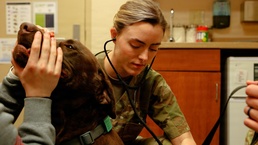
FORT BENNING, Ga. — Choco, a 1-year-old chocolate Labrador, has no idea he is about to fly 7,000 miles. As his military family prepares for a permanent change of station (PCS) to South Korea, the energetic four-legged family member has his own rigorous checklist to complete before he can board the Patriot Express. From microchipping to complex international health certificates and Fluorescent Antibody Virus Neutralization (FAVN) testing, Choco’s journey overseas begins at a critical—yet often overlooked—stop: the Fort Benning Veterinary Center.
For many Soldiers arriving or departing from Fort Benning, housing and unit in-processing take priority. However, for those with pets like Choco, the VetCen is an essential hub. And while the facility offers traditional veterinary services to keep military families’ pets healthy, its mission extends far beyond routine vaccinations.
Under the leadership of Capt. Madison Bartosh, the clinic’s officer in charge, the center serves as a hub for advanced medical care, force protection through food safety, and maintaining the tactical readiness of the Army’s most specialized "Soldiers": military working dogs.
Global mobility and PCS preparation Moving overseas with a pet requires navigating a maze of international agricultural and medical regulations. The Fort Benning VetCen provides the critical support Soldiers need to ensure their pets aren’t left behind. Flying with a pet requires a health certificate, and many countries — like South Korea, Japan, and some European nations — require FVAN testing and specific quarantine timeframes to prove a pet is rabies-free. "Planning your next tour overseas requires preparation," Bartosh noted. "Some countries require testing at least six months in advance. Get started early."
Owners executing an OCONUS PCS are encouraged to contact SATO for Patriot Express travel requirements and to use resources from the USDA Animal and Plant Health Inspection Service and the International Air Transport Association to navigate complex travel regulations.
Clinical capabilities and advanced care While many installation clinics focus strictly on preventative medicine, the Fort Benning facility operates as a full-service veterinary center with expanded diagnostic and surgical capabilities that rival civilian specialty centers. "Currently, we have a surgeon stationed here," Bartosh said. "We can offer more advanced procedures to clients ... including orthopedics, dental, and endoscopy."
The center uses an endoscopy tower to perform noninvasive internal examinations —such as bronchoscopies and colonoscopies — reducing recovery times for animals. The staff also includes a civilian veterinarian with a residency background in radiology, providing expert oversight for digital X-rays and ultrasound diagnostics.
The onsite pharmacy provides heartworm and flea prevention, often at a cost 5% to 15% lower than civilian providers. Available services also include sick-call exams, elective and advanced surgical procedures, and heartworm treatment**.**
Force protection and tactical readiness The VetCen is a first year graduate veterinary education internship site, mentoring new Veterinary Corps officers in clinical medicine and tactical requirements, such as K9 tactical combat casualty care. Beyond clinical care for privately owned pets, the Fort Benning VetCen manages a dual-priority mission: food defense and the medical readiness of tactical K9 assets.
As a critical component of force protection, Bartosh’s team conducts receipt inspections and audits of production facilities within a 250-mile radius of the installation. This mission prevents intentional or unintentional contamination of the military food supply. "What is the easiest way to take out the largest number of people? That’s with your food,” Bartosh said. "Our job is to ensure food defense is adequate."
The team performs 5 a.m. daily inspections at the commissary and child development centers, verifying that products meet the Department of Defense’s approved product list and are stored at appropriate temperatures before reaching a Soldier's plate.
Simultaneously, the center maintains the medical readiness of military working dogs. These K9 Soldiers are afforded the same medical priority as their human counterparts to ensure they remain mission-capable for patrol and detection duties. As essential tactical assets, MWDs take precedence in the clinic; in the event of a K9 emergency, routine appointments for privately owned animals are rescheduled to ensure the warfighter remains fit for duty.
"We view our MWDs as Soldiers in every sense," Bartosh said. "If they aren't medically ready, the Army loses a vital capability. Taking care of them is exactly like taking care of any other member of the squad—they are integral to the fight.”
Installation regulations and eligibility Army regulations require all personnel residing on the installation to register their pets with the veterinary center within 30 days of arrival. This registration is a prerequisite for living in government housing and ensures that all animals on the installation meet public health requirements, including current rabies vaccinations and microchipping.
Registration does not require an appointment or the presence of the animal; however, owners must bring all previous medical records to the clinic located at Building 265 on 10th Mountain Division Road. Services are available to active duty, retired, reserve, and National Guard service members on active duty, as well as their dependents. Per regulation, the facility cannot provide care for animals bred or raised for profit, nor does it provide pet adoption or stray boarding services. For the safety of staff and other patients, all pets must be on a leash or in a carrier while at the clinic (officials recommend all cats be placed in a carrier).
Center information and hours of operation Patrons may contact the Fort Benning VetCen directly at 706-545-4444 for information and appointments. Note, due to mission requirements, business hours are subject to change at any time and without notice.
| | |
Days of Operation - Operating Hours Monday\, Tuesday\, Friday 8:00 a.m. – Noon | 1:00 p.m. – 4:00 p.m. Wednesday 9:00 a.m. – Noon | 1:00 p.m. – 4:00 p.m. (Accommodates staff meetings) Thursday 8:00 a.m. – Noon (Closed in the afternoon for military training) Weekends & Federal Holidays - Closed Last Weekday of Every Month - Closed (Inventory)
Emergency Care:The facility does not provide 24-hour emergency care or continued hospitalization for critical care patients. Personnel experiencing a pet emergency outside of operational hours are referred to off-post emergency clinics in Columbus, Georgia, or the 24-hour facility in Auburn, Alabama.