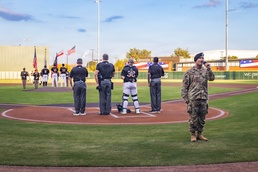
**FORT BENNING, Ga. –**For the Soldier-musicians of the U.S. Army Maneuver Center of Excellence Band, the mission is an exercise in duality: they must be both tactical warriors and world-class artists. As ambassadors for the modern Army, these individuals represent a career path where passion is forged into a profession, all while serving in the Defense of the nation.
While most Army career fields build skills from the ground up, the MCoE Band demands a display of pre-existing mastery from the start. The audition process is a rigorous prerequisite to enlistment rather than a mere formality. Spc. Samps Taylor, a tuba player, said the Army Music Proficiency Assessment is the gateway; before a contract is signed, the individual must prove they possess the technical caliber required to join the ranks of an Army band.
Once accepted, the musician’s transformation follows a structured pipeline that merges traditional combat readiness with specialized ceremonial training. Step one: attend Basic Combat Training, where civilians are transformed into Soldiers through tactical and physical conditioning. Step two: 10 weeks of Advanced Individual Training at the Army School of Music at Joint Expeditionary Base Little Creek-Fort Story, Virginia, where Soldier-musicians master the nuances of military performance. Here, Army musicians learn such things as marching maneuvers and how to conduct ceremonies, Taylor said. Basically, “how to use our music skills in the Army," he explained.
At Fort Benning, this training is immediately translated into operational impact. The band is a cornerstone of the MCoE mission, supporting more than 400 ceremonies and events annually. In an environment dedicated to training the Army’s newest Infantry and Armor forces, the band provides the musical framework for the graduations of thousands of new Soldiers. "We are the first professional representation of the Army that many families see," said Warrant Officer 1 Lauren Assad, the band’s commander. “When the band performs for the 197th and 198th Infantry Brigades or the 194th Armored Brigade,” she said, “it is not merely playing music, it is scoring the pivotal transition from trainee to Soldier.”
A common misconception suggests the lives of Soldier-musicians are separated from the standard Army experience. Staff Sgt. Joel Mauricio, drummer with more than 30 years of experience, views his role as a balanced dual identity. “We are Soldiers, we are Soldier-musicians,” Mauricio said, emphasizing that the unit maintains the same tactical standards as any other – they qualify at the range, conduct rigorous physical fitness training, and perform Soldier tasks alongside their peers in combat.
The role of Soldier-musician provides a level of professional stability rarely found in the civilian music industry. Sgt. Anita Rodriguez, a French horn player, noted that the Army offers a consistent career path and a professional salary, allowing musicians to reach their full potential without the volatility of the commercial market. "It's one of the most stable careers that you can have as a musician," she said. "In the Army band, you can make a salary."
The mission footprint extends far beyond the parade field. From supporting high-visibility events unique to Fort Benning, such as Infantry and Armor Week, to performing for international audiences, the band serves as a vital link between the civilian public and the military installation. Assad recalled the profound impact of performing in France for the 75th anniversary of D-Day, noting how the gratitude of a public once liberated by the U.S. military leaves an indelible mark on every performer. “Witnessing a public that experienced the impact of the U.S. military ... it just sticks with you forever,” she said.
The Army also fosters a culture of internal advancement. Assad’s own career — transitioning from an enlisted bassoon player to warrant officer and conductor —illustrates the upward mobility available within the career field. She noted that the discipline, adaptability, and technical proficiency developed in the band are transferable skills relevant to many other Army career fields, including logistics or armor.
For members of the MCoE Band, success requires maintaining a high standard of excellence in both musical performance and tactical Soldier skills. By merging their creative passions with military service, these Soldiers embody the spirit of ‘Be All You Can Be,’ ensuring Army traditions are preserved through every professional performance.