Few things strike a chord with Americans more than the regard we hold for our Nation’s warfighters. Feelings of pride, reverence, gratitude and good will play alongside feelings of deep empathy and concern for warfighters’ safety and well-being. Those working in organizations that develop capabilities to support our warfighters share these same sentiments. Their mission is to deliver integrated capability sets that enhance operational readiness and secure mission success, ensuring warfighters are safe and victorious on the battlefield.
The Capability Program Executive for Chemical, Biological, Radiological and Nuclear Defense (CPE CBRND) develops CBRN defense capabilities that enable our warfighters to fight and win in CBRN-contested environments. A concerted effort is made to achieve integrated layered CBRN defense across all warfighting domains and functions; in part, through an orchestra of capabilities that play independently but also perform in harmony to achieve greater mission outcomes. Integration refers to the coordination and connection of capabilities to function as a unified whole, while layered is the arrangement of capabilities within a system so that each serves a purpose and complements the others. Together, integrated layered defense serves as a strategic effort that combines multiple layers of protection to safeguard our Nation’s warfighters against threats.
Last fall, CPE CBRND’s Joint Project Manager for CBRN Integrated Early Warning (then Joint Project Lead for CBRN Integration) conducted integrated testing of an ensemble of CBRN capabilities during an Integrated Layered Defense Capstone event at Aberdeen Proving Ground, Maryland. While capabilities undergo continuous individual operational testing throughout the traditional acquisition process, the JPL CBRN Integration team aimed to enhance this approach with a holistic system-of-systems view that tests multiple capabilities as they perform together.
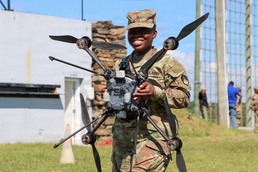
The capstone tested seven CBRN reconnaissance systems in realistic, multi-domain scenarios to gain a comprehensive understanding of how CBRN capability sets in development interact directly with each other. This was achieved through several key objectives, including validating the effectiveness of the integrated layered defense architecture for mounted and dismounted reconnaissance mission capability sets; identifying and evaluating key interfaces among reconnaissance mission equipment; and gathering and analyzing data for risk-reduction, informed decision-making, and insights into emerging technologies that enhance reconnaissance missions.
This complex, multi-layered testing event required substantial planning and orchestration. Monicia Hall, integrated layered defense assessment testing and evaluation lead, states, “There was definitely some socialization that had to happen at the higher levels to introduce the concept and get people on board.” Once the concept was socialized, all players agreed that the capstone would provide value for everyone involved and, ultimately, the warfighter. The team also had to decide which practice missions to run and what equipment to test. Some of those systems were approaching acquisition milestones while others were still in the early development phase. The event would allow for valuable data collection and user feedback regardless of where the capabilities were in the development pipeline.
Collaboration was essential to the execution and success of the ILD Capstone. The JPM CBRN Integrated Early Warning team moved in counterpoint with other organizations including the U.S. Army Combat Capabilities Development Command Chemical Biological Center, the U.S. Army Test and Evaluation Command, U.S. Army CBRN School, as well as 27 Soldiers from diverse military occupational specialties and experience levels to gain valuable feedback and critical insights, and to inform future system concepts and improvements. This feedback was primarily collected through debrief sessions, surveys, and data collected by individual program managers.
Though the event required monumental effort to plan and execute, the team agrees that testing capabilities concurrently in an operational environment is the optimal way to identify potential issues and make improvements. Chris Niblick, enterprise test and evaluation lead, states, “The purpose of this event was to understand our system of systems while they’re still in development. This allows us to make changes based on what we have learned while there is still time to make changes.”
Bringing it back to the warfighter, Hall concurs, “It was helpful for them to see how the capabilities could be used holistically in a mission rather than having them piecemealed. It gave them a little bit more information about how they might interact with each other and where improvements could be made.”
It takes a composer up to eighteen months to write a score for a two-hour symphony, from conceptualization to arrangement. What took the team over one year to plan and coordinate culminated to two and a half weeks of invaluable execution. The capstone demonstrated successful interoperability of the tested systems, produced feedback for enhanced operational readiness and mission success, and generated data that will support decision-making and informed development of future concepts. Participants across the board found great value in the event and have expressed interest in conducting additional events like it, setting the stage for continued integrated layered capability testing. There are no interludes or finales in the world of acquisition, but the mission is always to create harmony between the capabilities the CPE CBRND develops and the warfighters who use them.