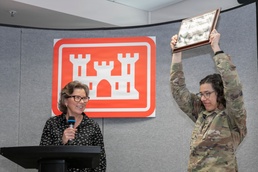
The U.S. Army Corps of Engineers’ (USACE) Walla Walla District is part of the first team ever to receive the USACE National Regulatory Team of the Year, recognized during the 2025 USACE National Awards ceremony earlier this year.
The award honors a cross-functional team led by the district’s Regulatory Branch and supported by USACE personnel from across the country. Team members were recognized for managing the Stibnite Mine Project in Idaho, one of USACE’s most complex and closely watched regulatory efforts, while coordinating with tribal nations, cooperating agencies, stakeholders, and senior leaders throughout the process.
The Stibnite Mine Project drew national attention because of both its environmental complexity and its broader strategic significance. According to the Army, the site contains the largest identified reserve of antimony in the United States, estimated at 148 million pounds, and could become the nation’s nearest-term domestic source of military-grade antimony sulfide, a material used in ammunition production. Army officials have said the mine could help strengthen supply chain resilience for critical defense materials, while project plans also include major environmental restoration work at the historic mine site.
“(This award) is a tremendous honor and a powerful testament to the collaboration that defined work on the Stibnite Mine Project,” said James Joyner, supervisory environmental resources specialist with the Walla Walla District. “Our success hinged on a deeply integrated, cross-disciplinary approach. The Team didn’t work in stovepipes but collaborated horizontally and vertically to meet a shared goal.”
That collaboration proved essential on a project of unusual scale and visibility. The Army announced in September 2025 that the Stibnite effort supports a broader push to reestablish a domestic source of antimony sulfide after years of foreign dependence. Military Times later reported that, during its first six years of operation, the project is expected to supply up to 35 percent of U.S. antimony demand, while also helping restore habitat and address legacy impacts from historic mining in the area.
“Our team of specialists tackled the complex task head-on, and it was our communication habits that allowed us to successfully navigate the puzzle,” said Benjamin Wilson, Senior Project Manager, Albuquerque District, USACE.
For the Regulatory Program, the recognition underscores the power of effective, forward-thinking regulation while highlighting the value of early coordination, communication, and sustained engagement across agencies and affected communities on projects which carry environmental, economic, and national security implications.
“(The project) serves as a strong example of this team’s capabilities, showcasing how a cohesive, interdisciplinary group of talented professionals can effectively collaborate to achieve a common goal,” said Kristen Hader, Division Regulatory Program Manager, Northwestern Division, USACE. “Their approach to this challenging project was exemplary. The team not only developed innovative solutions but also implemented a robust communication strategy to ensure all agency and tribal partners, as well as senior leadership, were kept informed of critical decisions and timelines.”
The award marks a milestone for both the Walla Walla District and the USACE Regulatory Program. As USACE continues to support the nation through infrastructure, environmental stewardship, and permitting decisions, the team’s work on Stibnite stands out as an example of how collaboration, transparency, and technical expertise can help move a complex project forward.