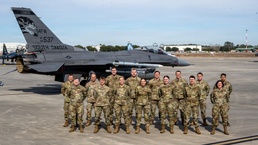
SAVANNAH, Ga. — Airmen from the Kansas Air National Guard’s 134th Air Control Squadron played a central role in Exercise Sentry South (Savannah) 26.1, Jan. 20–30, 2026. They provided the command-and-control backbone for large scale counter air operations during the two-week training event held at the Savannah Combat Readiness Training Center.
The exercise brought together 1,745 service members and 86 aircraft from 54 units across 26 states, creating a complex training environment designed to prepare joint forces for high-end conflict.
Operating from the Savannah CRTC’s War Room, the 134th ACS served as the primary command and control element for the exercise, coordinating aircraft, managing the air picture and distributing targeting information to pilots.
Using the Battle Control Center (BC3) system and the Distributed Radio Management System, controllers monitored the battlespace and transmitted critical targeting and situational awareness information to aircraft through the Link 16 network.
For Maj. Morgan Huttes, director of operations, 134th ACS the exercise represented a shift from previous events by focusing primarily on operational training for controllers rather than experimentation with emerging technologies.
“The biggest difference between this event and past exercises was the primary audience was the operator themselves,” Huttes said. “For Sentry Savannah, the focus was on the operator to train and integrate with pilots and other aircrew to execute current tactics.”
During the exercise, the 134th ACS worked alongside fourth- and fifth-generation fighter aircraft, including F-22 Raptors and F-35 Lightning IIs. Controllers adapted their communication and information flow to support advanced aircraft operating across multiple domains. “Those platforms have unique information requirements that are different from fourth-generation assets,” Huttes said. “As command and control, we always have to look at the larger picture and provide direction on follow-on priorities as the engagement evolves.” The squadron also faced challenges operating on equipment that differed from their home station system, requiring Airmen to adapt quickly to maintain effective control of the battlespace.
“Interfaces and workflows that our Airmen are familiar with at home station looked and felt different at the exercise,” Huttes said. “What I was proud of was how the squadron responded to that challenge.”
Beyond technical proficiency, the exercise provided younger Airmen with opportunities to step into new responsibilities while operating in a high-pressure environment alongside experienced operators and aircrews.
“What made me most proud was watching some of our younger Airmen step completely out of their comfort zones and not just perform, they shined,” Huttes said. “Those Airman stepped up and took on tasks they had never done before.”
Exercises like Sentry South provide training opportunities that cannot be replicated at home station, exposing Airmen to the complexity, scale and friction of real-world operations.
“In a simulator environment, radios are crystal clear and the radar picture is pristine,” Huttes said. “The real world doesn’t work that way. This exercise put our Airmen in that environment and forced them to perform.”
For the 134th ACS, the experience strengthened the squadron’s ability to manage complex air operations and reinforced the importance of realistic training in maintaining combat readiness.
“Every time we take this squadron through an exercise like this, we come back with a sharper team and a more honest training program,” Huttes said.