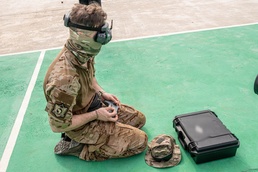
JACQUEVILLE, Côte d’Ivoire — For the first time, exercise Flintlock has integrated a comprehensive small Unmanned Aircraft System familiarization course, signaling a shift in how African and international partners prepare for emerging security challenges.
The course, held April 14–17, 2026, brought together 25 participants from 15 nations to build foundational drone skills and strengthen multinational cooperation. About half of those participants were working with drones for the first time, underscoring the growing need for accessible training as unmanned technology spreads across the continent.
Led by U.S. active duty and National Guard personnel, the familiarization course focused on practical applications. Participants learned basic flight operations, drone construction, and how to use aerial platforms for intelligence, surveillance, and reconnaissance. The course also introduced concepts such as 3D printing for low-cost drone production and foundational counter-sUAS awareness.
“This course is about proactively addressing the changing character of warfare,” said a U.S. special operations instructor. “We are bringing together U.S., international, and African experts to exchange best practices against a shared threat. By combining cutting-edge technology with the invaluable, on-the-ground experience of our partners, we build collective readiness and interoperability.”
Drone technology is becoming increasingly relevant across Africa. Instructors noted that both military forces and extremist groups are beginning to adopt unmanned systems, making early familiarization essential.
“Recognizing these systems and understanding how to use them, or counter them, is critical,” the instructor added.
The impact of the familiarization course was evident during exercise scenarios. Partner forces used drones to conduct pre-mission ISR, allowing units to observe objectives, identify potential threats, and adjust plans before launching operations. In one instance, a unit was able to map out enemy positions ahead of a raid, improving coordination and execution.
“The more intelligence you have, the easier operations become,” the instructor said.
African partner nations also contributed to the familiarization course, bringing their own and sharing operational insights. Despite differences in equipment, participants found common ground due to the similar design and function of most small drones.
The course also highlighted cost-effective solutions. Instructors discussed alternatives such as commercially available drones and locally produced components using 3D printing, enabling partner nations to sustain capabilities within their means.
Beyond the classroom, the training reinforced collaboration and information exchange. African partners with recent operational experience provided mentorship through demonstration of sUAS integration and discussing how they support border security by extending surveillance over vast and difficult terrain.
As exercise Flintlock continues, the integration of sUAS training reflects a broader evolution in multinational operations, one that prioritizes adaptability, shared knowledge, and practical technology.
“These systems are a critical tool,” the instructor said. “They provide us with real-time intelligence and surveillance, improving situational awareness for our troops and helping to safeguard civilian lives.”
-30-