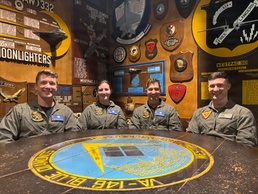
For most student naval aviators and naval flight officers, aviation training is a personal test of discipline, resilience and skill. For the Martineau family, it is more of a shared journey.
Four siblings serving across Navy and Marine Corps aviation pipelines have found themselves navigating the same demanding path at the same time. What might seem like a coincidence, they describe as something deeper, family values, faith, competition, and a rare support system that only siblings could fully appreciate. “We were just some home school kids from West Virginia,” said Lt. j.g. Thomas Martineau. “Now we’re here, operating in naval aviation. It seems like a series of coincidences, but I’d say it’s something more than that.”
Today, four out of five Martineau siblings are currently in the naval aviation training pipeline and three of them are attached to the same squadron, flying the same platform.
1st Lt. Sean Martineau, the oldest, is a U.S. Marine Corps Naval Aviator assigned to the “Raptors” of Marine Medium Tiltrotor Training Squadron 204 at Marine Corps Air Station (MCAS) New River, flying the MV-22B.
Lt. j.g. Thomas Martineau, is the second oldest and is a Student Naval Flight Officer assigned to the “Sabrehawks” of Training Squadron (VT) 86, flying the T-45C Goshawk.
Ensign Chris Martineau and Ensign Kelly Martineau are twins and the youngest sbilings, they are both SNFOs assigned to the “Sabrehawks” of Training Squadron (VT) 86, flying the T-45C Goshawk.
1st Lt. Sean Martineau, the only Marine and only naval aviator out of his siblings, began his path in Quantico, Virginia, at The Basic School, where all Marine Corps officers are trained to lead Marines. After completing TBS, he transitioned into naval aviation training at Naval Air Station (NAS) Pensacola where his younger siblings would soon follow.
Despite slight differences in timelines, their careers have overlapped in ways that are unheard of to include being placed in the same squadron. “When I checked in, the commander looked at me and said, ‘Oh you’re the third Martineau, we’ve been waiting for you,’” Ensign Chris Martineau joked.
Unlike Sean, Thomas, Kelly, and Chris arrived in Pensacola, as NFO candidates. NFOs operate mission systems and serve as mission commanders, navigators, and weapons systems operators aboard aircraft. At NAS Pensacola, every naval aviator and NFO experiences training the same way, with high standards, intensity and constant evaluation.
Their inspiration to serve comes from three generations of family members who served in the Army, Navy, Air Force and Marine Corps, including service in World War II and the Cold War. However, the Martineau siblings emphasize that joining the military was ultimately a personal decision for each of them.
Ensign Chris Martineau stated, “God just kind of individually called each and every one of us,” adding that “it was more of a calling instead of a pressure.”
The fast-paced flight training curriculum coupled with time-critical-decision making is an intimidating challenge. Within this environment, the Martineaus endured a shared experience that brought them closer together. They described it as a mixture of competition and support.
The Martineau siblings have long relied on competition to push one another. “Growing up with all the boys, I had to keep up somehow,” said Ensign Kelly Martineau. “But seeing Thomas go through it before me was definitely like, okay, he set the standard, now I have to beat it.”
“I was pretty happy with my performance,” said Ensign Thomas Martineau. “Then Kelly came through and blew mine out of the water. And then Chris beat hers. It was humbling, but also awesome to see.”
The Martineaus describe their tight family bond as a major factor in their success. Although they train individually, their shared experience creates a constant support system that makes the process feel like a team effort.
“It’s fun to compete,” said Ensign Chris Martineau. “But at the end of the day, we’re always here for each other.”
Despite the intensity of flight training, the Martineaus emphasize that their identities extend beyond aviation.
“I am husband, a father, and a brother first,” said Thomas Martineau.
That mindset helps them navigate setbacks, something that every SNAs and NFOs will encounter during their training.
“Everyone gets knocked down,” said 1st Lt. Sean Martineau. “The key is not letting that define you. You just get back up and keep going.”
It is clear the Martineau family has a bright future in the fleet. However, they emphasized that their success stems from countless moments of struggle that pushed them to improve. Ensign Kelly Martineau added that it is vital to “accept advice and criticism” and be able to bounce back.
From a small town in West Virginia to the cockpits of naval aircraft, the Martineau story is a proof that success in naval aviation isn’t about where you start, but how you move forward.
Headquartered at Naval Air Station Corpus Christi, Texas, the Chief of Naval Air Training (CNATRA) oversees five training air wings and 17 training squadrons across Florida, Mississippi, and Texas. These squadrons conduct primary, intermediate, and advanced flight training for student naval aviators, naval flight officers, and air vehicle pilots. CNATRA remains steadfast in its mission to train, mentor, and deliver the highest quality naval aviators prepared to win in competition, crisis, and conflict.