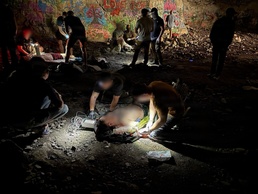
The day after praising the West Virginia National Guard’s Ridge Runner Irregular Warfare Exercise & Laboratory while testifying before the Senate Committee on Appropriations, Chief of the National Guard Bureau, Gen. Steve Nordhaus, trekked from Washington, D.C., to Camp Dawson, West Virginia, to experience the program firsthand.
Camp Dawson is a small military base sitting on a shallow river nestled between steep hills in rural Preston County, West Virginia. A hidden gem, it’s home to Ridge Runner (RR), a uniquely innovative and globally influential joint multinational training program, innovation laboratory, and U.S. Special Operations Forces validation platform.
Gen. Nordhaus attended his first RR IWX & Laboratory Distinguished Visitors Day on April 22, 2026, at the invitation of WVNG Adjutant General, Maj. Gen. Jim Seward, and Ridge Runner Program Director, Col. Tyler Vaughn.
Alongside more than 100 industry, academic, and U.S. and foreign military liaison officers in attendance at DV Day, the CNGB joined the Deputy Assistant Secretary of War for Irregular Warfare and Counter-Terrorism, Colby Jenkins; Irregular Warfare Center Director, Dr. Dennis Walters; former commander of the U.S. Army Special Operations Command and current Chairman of the Green Beret Foundation, Lt. Gen. (R) Kenneth Tovo; Maj. Gen. Dan Degelow, Chief of Staff for the U.S. Army National Guard; and Maj. Gen. (R) Eric Vollmecke, who works as director for the Rapid Prototyping Research Center at George Mason University.
“When you think about where we have come as a nation in 390 years … we have always faced uncertainty,” Maj. Gen. Seward said during opening remarks. “But things like Ridge Runner and Ridge Healer, they take that uncertainty and they turn it into lasting freedom.”
Ridge Runner has quietly influenced SOF communities and the IW realm for decades, always operating out of the rough and primitive environments around West Virginia. The past four years, however, have seen exponential growth and the momentum has led to RR-IWX being named as a primary training exercise for 1st Special Forces Command (Airborne), in addition to supporting annual baseline lethality training and Irregular Warfare training for Special Operations Task Force components.
“This laboratory is at the forefront of taking the irregular and making it become regular,” said Mr. Jenkins, who spent his military career as a Green Beret. He emphasized that the synchronization of military and non-military means to achieve desired strategic effects requires the type of innovation and solutions grown by those who experience Ridge Runner.
Drone warfare and “harnessing innovation from Citizen Soldiers to address the new age of warfare” were the lines of questioning for Gen. Nordhaus from U.S. Senator Shelley Moore Capito (R-W.Va.), a member of the Senate Appropriations Subcommittee on Defense, during the April 21, 2026, hearing to review the President’s fiscal year 2027 budget request for the National Guard and Reserve Forces.
“I would say the Ridge Runner Irregular Warfare Exercise & Laboratory … provides some of that,” Capito said.
Mr. Jenkins, returning for his second DV Day, reinforced his support for the innovation that surrounds Ridge Runner and the realistic IW training environment of constrained or contested areas that warfighters are required to work against.
“[Irregular Warfare] needs to become a standard muscle that is exercised over and over,” Mr. Jenkins said. “Here is the laboratory, and I encourage you all to continue to support this, to invest in this as much as you can.”