No Refrigeration Needed
Army Medics Learn Walking Blood Bank Transfusion Techniques during Combined Resolve
Story and Photos by U.S. Army 1st Sergeant Lisa Rodriguez-Presley
HOHENFELS, Germany – Combined Resolve 26-07 is increasing more than battlefield lethality, as U.S. Army combat medics from the 3rd Brigade, 1st Cavalry Division train to provide lifesaving care and return wounded Soldiers to the fight.
“Walking blood banks are something you only see in combat situations,” said Master Sgt. Daniel Tumey, an Observer Coach/Trainer with Joint Multinational Readiness Center, Team Adler. “In cases where blood supplies are running critically low, soldiers have the opportunity to save lives by giving whole blood for immediate use.”
According to Tumey, medics rarely have the opportunity to practice giving blood transfusions, which is a highly perishable skill. Even rarer is the opportunity to set up a “walking blood bank,” where whole blood is taken from soldiers and immediately transfused to casualties who can’t wait for traditional blood supplies to be replenished.
“I have some soldiers say to me that they’ve done this training in Advanced Individual Training, but I haven’t seen a lot of providers doing training like this at home station,” said Tumey. “Blood kits are very expensive, and a lot of the soldiers coming through here say that they’ve never done transfusions before, but as a combat medic, you’re expected to know how to do it.”
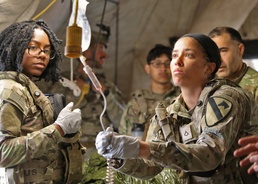
For the exercise, patients served as both donors and recipients of their own blood. Combat medics took blood from the patient, checked the blood type using a blood kit, and then transfused the soldier’s own blood back into their body, giving the medics real-world experience that can’t be replicated any other way.
“The only time I’ve done a blood transfusion in the Army was during AIT,” said Pfc. Fantashia Carroll, a combat medic with 3rd Brig. 1st Cav. Div. “This training is really helping me with my skills since I’m doing so many repetitions, and for future patients, I’m able to perform better.”
The risk during the procedure is low, but not zero, according to Sgt. 1st Class Joseph Pischieri, an Observer Coach/Trainer with JMRC, Team Adler. Infection, adverse reactions to medication, and other complications are always a possibility.
“This is as much an art as it is a skill,” said Pischieri. “The more you practice, the more you develop techniques that work better for you. Everyone has little differences in how they teach these skills, so you take what you’re taught, and you work to improve on it.”
According to Tumey and Pischieri, the exercise allows them to mentor and instill confidence in young medics, increasing the proficiency of those who care for wounded soldiers. These efforts help ensure that casualties receive the best possible care, even under the worst conditions.