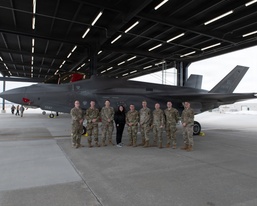
F-35 training builds teamwork between 104th and 115th fighter wings Story, Photos and Video by Melanie J. Casineau, 104FW/PA
BARNES AIR NATIONAL GUARD BASE, Westfield, MA-Change can be challenging, but it also brings opportunity. In recent months, airmen from the 104th Fighter Wing have intensified training in preparation for the arrival of the F-35, working closely with the 115th Fighter Wing in Madison, Wisconsin.
While several locations across the country support F-35 training, the 104th has frequently partnered with the 115th to gain hands-on experience with the aircraft and its systems.
The wing has a long history of evolving through multiple aircraft generations, from the P-47 to the F-15 and now the F-35. With the addition of the F-35, the wing will have operated eight different aircraft.
U.S. Air Force Senior Master Sgt. Adam Casineau, 104th Fighter Wing aerospace ground equipment superintendent, recently visited the 115th to manage, equip and train on F-35 ground equipment.
“As our wing converts to the F-35, all the equipment changes along with it,” Casineau said. “Fifth-generation fighters bring advanced systems that we don’t have experience with in the F-15 career field.”
We must replace aging aircraft at the end of their service life as we did with the F-15. The F-35A is the most advanced multirole fighter aircraft in the world and plays a critical role in national defense.
“The systems in Madison are relatively new,” Casineau said. “Ours date back to the ’50s and ’60s and look nothing like this.”
Casineau plans to compile a visit report so his team can compare current practices at the 115th with those at the 104th and develop updated procedures.
The transition to the F-35 brings significant differences. While the F-15 Eagle focuses on air-to-air superiority, the F-35 supports both air-to-air and air-to-ground missions. Its avionics systems are more advanced, and administrative requirements, including manning, infrastructure and program documentation are also evolving.
U. S. Air Force Tech. Sgt. Kyle Cote, 104th Fighter Wing F-35 advanced fighter integrated avionics technician, is spending two months training with the 115th.
“Basic maintenance practices like swapping parts and routine servicing stay relatively the same, but the jet is fully digital now,” Cote said. “We’re also taking on responsibilities previously handled by the electrical and environmental shop. We’ll be doing more software loads and running diagnostic checks than we did on the F-15.”
U.S. Air Force Senior Master Sgt. Dan Tourtellotte, 104th Fighter Wing aircraft maintenance unit chief enlisted manager, said troubleshooting will also change.
“The F-15 required a hands-on approach to diagnose issues,” Tourtellotte said. “The F-35 is essentially a flying computer. It can diagnose itself and provide codes that guide maintainers toward a fix.”
While hands-on tasks such as engine swaps and servicing remain necessary, much of the work now relies on systems like the Primary Maintenance Aid. These systems continuously update, improving efficiency and accuracy over time.
Tourtellotte said the goal is to apply lessons learned from other units to build processes tailored to the 104th.
“Each unit we visit has its own way of doing things,” he said. “Barnes has always led in excellence, and these visits show our commitment to preparing our base and Airmen for the future.”
U.S.Air Force Master Sgt. Bill Sabadosa, 104th Fighter Wing support section NCO in charge, also visited the 115th to learn about the Autonomic Logistics Information System, or ALIS. The system serves as the IT backbone of the F-35, integrating training, planning, maintenance and support functions.
“Master Sgt. Brett Sabin from the 115th has shared products that will help us navigate ALIS more effectively,” Sabadosa said. “They’ve developed tools that make it easier to track both legacy and program items.”
In addition to training in Madison, the 104th’s core cadre personnel have worked with units at Hill, Luke and Eglin Air Force bases to become fully qualified to support future training.
“There will be a steep learning curve,” Cote said. “But with the support from units across the Air Force, we’ll be ready for the challenge.”
The 104th expects to receive its first F-35 Lightning II aircraft in June 2026. The transition will expand mission capabilities at Barnes Air National Guard Base and ensure the wing remains a premier fighter unit.
“The 104th is a great fit,” said Maj. Gen. Gary W. Keefe, adjutant general of Massachusetts. “They have years of fighter experience, strong community support and a strategic location for homeland defense.”