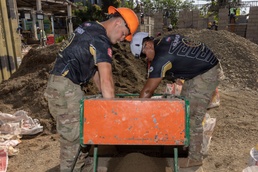
Soldiers from the United States and service members from the Armed Forces of the Philippines continue construction operations in Barangay Tinib, Casiguran, Aurora, Philippines, in support of an engineering civic action program as part of Exercise Balikatan 2026, March 23– May 08.
More than eight decades after the conclusion of World War II, the legacy of cooperation between the U.S. and the Philippines continues to flourish. U.S. Army engineers are working in close coordination with their partners from the AFP to revitalize the local infrastructure in Barangay Tinib.
Working side by side, U.S. and AFP engineers are constructing a 30-meter-by-8-meter educational facility. This new schoolroom is designed to expand local classroom capacity and provide a significantly improved environment for students in the region. Across the site, construction progress remains steady. Structural elements are rising as materials are carefully staged and measurements verified through a seamless, coordinated workflow between the two nations.
For the participating service members, this mission is steeped in historical significance. Elements of the 523rd Engineer Support Company trace their lineage to World War II, when U.S. Army engineer units were activated in 1944 and subsequently inactivated within the Philippine archipelago following the cessation of hostilities. During that period, these units were vital in providing construction, repair and sustainment in austere environments. Today, that historical thread remains unbroken, reflecting in a modern partnership characterized by shared execution and mutual respect.
Alongside U.S. forces, the project benefits greatly from the specialized expertise of the 355th Aviation Engineer Wing of the Philippine Air Force. By integrating their aviation engineering proficiency and regional knowledge, the AFP engineers contribute to a more robust and efficient construction process. This partnership highlights the evolving capabilities of Philippine engineering while showcasing the high degree of interoperability between U.S. and Philippine forces.
Throughout the build, engineers from both nations have aligned their operational timelines, shared resources, and exchanged technical methods. This exchange reinforces their collective ability to operate effectively as a combined force while delivering tangible benefits to the local community.
The impact of this initiative extends far beyond the physical structure. “This project is about more than construction,” said U.S. Army 1st Lt. Madison Kusano, the officer in charge of the ENCAP site. “It’s about working together, learning from one another and building something that will continue to serve the community.” The construction effort is part of a broader humanitarian civic assistance mission that includes medical engagement, specialized training, and community outreach programs across the region. Together, these efforts address the immediate needs of Barangay Tinib, while facilitating long-term development and reinforcing the enduring bond between service members and the local residents they serve.
Balikatan is a longstanding annual exercise between the AFP and U.S. military designed to strengthen our ironclad alliance, improve our capable combined force, and demonstrate our commitment to regional security and stability.