By Pachari Middleton Anniston Army Depot Public Affairs
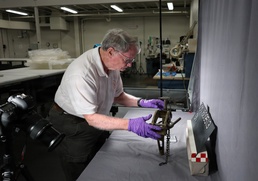
Charlie Webb works amongst the field-worn memorabilia of war at the Museum Support Center-Anniston. With a camera, careful eye and steady hand, Webb spent 15,000 hours over the past decade photographing and cataloging historic military memorabilia for MSC-A.
After retiring from the Army in 1993, Webb eventually made his way to Anniston Army Depot, where he worked at the incinerator complex for 14 years. Webb was asked by a museum employee to help photograph artifacts for the MSC-A once they arrived, and he’s been volunteering with the repository ever since.
“For a retired guy, I couldn’t have fallen into a better opportunity. I get to see the stuff. I can hold it. Occasionally, though, it makes you feel old when you open up a crate and there’s clothing you used to wear,” Webb said. On one occasion, Webb opened a container and found himself faced with the guidon flag from his old unit at Fort Bliss, Texas. “It was like seeing an old friend,” he recalled.
Over the years, he has handled artifacts that span conflicts, continents and decades and the work often brings surprising discoveries.
“The stuffed cayman alligator from Manuel Noriega’s office was interesting,” he said. “The Abraham Lincoln letter is high on the list.”
The letter he refers to is a telegram dated April 18, 1865, to the Watervliet Arsenal commander with instructions for Abraham Lincoln’s funeral.
The MSC-A is one of two repositories for the Army Museum Enterprise (AME) to store portions of the Army Artifact Collection, with nearly 83,000 square feet of climate-controlled space. From cavalry saddles and German combat helmets to Vietcong uniforms and Spanish War Service medals, the MSC-A is the largest storage facility for the AME.
“The MSC-A stores approximately 122,000 artifacts, to include around 11,000 small arms,” said Christel Sanchez, MSC-A’s Museum Curator.
According to Sanchez, Webb’s photography directly benefits the AME’ s Army Historical Collection Accountability System (AHCAS) database.
“AHCAS is used by Army Museum curators and staff to help them identify artifacts for creating new exhibits or updating existing displays. These photographs help curators research collections remotely. Charlie’s photography captures the physical condition of artifacts and has even helped us correct records,” Sanchez explained.
Behind every photograph and catalog entry is a quiet commitment to preserving the past. Through patience, research and respect for the history in his hands, Webb said he is helping ensure the stories behind these artifacts are not lost to time, but instead remain accessible to those who come looking to understand the people and moments that shaped history.
“Photography is actually a time machine. You take a picture of stuff today and years from now, people are going to say, let’s go look at that,” he said.
<br>