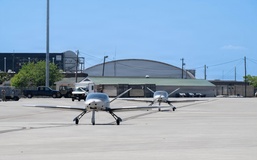
TYNDALL AIR FORCE BASE, Fla. — Airmen and F-35A Lightning II aircraft from the 95th Fighter and Fighter Generation Squadrons deployed, April 13–17, 2026, to Savannah Air National Guard Base, Georgia, to enhance combat capability and lethality during Exercise Ready Tiger 26-3.
Ready Tiger Exercise is designed to test Airmen’s ability to rapidly deploy, sustain operation and generate airpower in simulated austere environments. During the exercise, pilots, intelligence personnel and maintainers generated sorties to detect and eliminate low-observable aerial targets, mimicking drone attacks. This tested Airmen’s ability to operate in hazardous conditions, strengthening their combat readiness for future operations in contested environments.
“Low-observable planes are very hard to detect with radar,” said Maj. Heath “Shady” Williams, 95th FS chief of operations group standardization and evaluations. “The best way to overcome the challenge is practice and repetition.”
While drones are slower than the F-35A, they operate at lower altitudes and present detection challenges that require precise sensor employment and coordination to defeat.
Williams explained the biggest challenge was incorporating senor-setting recommendations from pilots with real-world experience and applying them to the F-35A aircraft, serving as a key building block in ensuring a higher level of fidelity against these drones.
Throughout the exercise, Airmen worked with Marine Corps F-35B Lightning II aircraft units operating out of McEntire Joint National Guard Base, South Carolina, sharing lessons learned across the F-35 community. The joint collaboration allowed the services to refine tactics, improve targeting processes and strengthen interoperability across formations from dispersed locations, enabling teams to overcome communication challenges they may experience during deployed locations.
“It brings in a level of difficulty because we are not physically across the table from one another,” Williams said. “But when we get out there, there is a level of understanding…so, we are at least on the same operating page and common thought process on how to mitigate these drones.”
Reinforcing joint-force interoperability enhances integration, enabling synchronized operations and strengthening the delivery of combat airpower in any environment.
“When you bring another formation from the Marines, Navy or whoever…we are able to essentially just hit play and execute the tactics that are recommended,” said Williams.