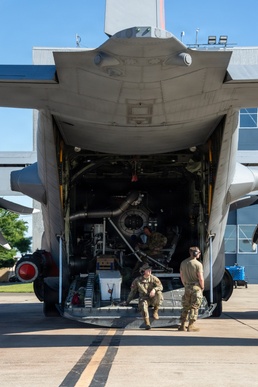
MCCLELLAN AIR TANKER BASE, Calif. — Long before a Modular Airborne Fire Fighting System-equipped C-130 aircraft ever leaves the runway, the mission is already underway on the flightline, where maintainers work behind the scenes to ensure every aircraft is ready when it matters most. MAFFS spring training took place April 19-25, bringing together aircrews, maintainers, and support personnel for annual training ahead of the wildfire season.
For MAFFS aircraft crew chiefs, the day starts early and often ends late. Maintainers arrive before the aircrew, open the aircraft, and verify it is mission-capable.
“We’ll get here early in the morning before the aircrew does, open up the aircraft, and make sure it’s ready,” said Master Sgt. Chris Crossley, lead crew chief with the Nevada Air National Guard’s 152nd Airlift Wing.
Then they wait, ready for the call.
Once launch orders come in, the pace shifts instantly. “Aircrew will step to the plane, and we’ll make sure the aircraft is 100% ready for them,” Crossley said. “Then we’ll send them up, and they’ll complete multiple water drops.”
When the aircraft returns, maintainers go right back to work preparing it for the next water drop. The cycle may repeat throughout the day, weather permitting. “We’re the first ones in and the last ones out,” Crossley said. “It’s 12-hour days, if not longer, just making sure the aircraft is ready.”
Even during flight operations, maintainers remain on standby near the flight line. “When they’re flying, we’re their support system,” said Staff Sgt. Skyler Marsden, assistant crew chief with the 152nd Airlift Wing in Reno, Nevada. “If something breaks between flights, we troubleshoot it and figure out if the aircraft can keep going.”
While partner agencies such as CAL FIRE manage reloading operations during training missions, maintainers stay focused on aircraft readiness.
“We don’t handle the tanks, but we’re there for fueling, equipment, and anything that comes up,” Marsden said. “We’re big assistants to the aircrew.”
Operating in a MAFFS training environment presents unique challenges, especially with limited personnel. “Out here, it’s just us two and our plane,” Crossley said. “We don’t have the same support we would back home.”
That makes coordination with mission partners critical. “We’ve been working with CAL FIRE closely,” Crossley said. “We’re at their base, and they’ve been super helpful. They let us use their equipment and support us whenever we need it.”
Maintainers also provide key updates that help shape daily operations. “We keep them updated on aircraft status so they know what’s available,” Crossley said. “That helps them plan their missions.”
Much of the responsibility falls on a small team supporting their assigned aircraft. “Right now, it’s just the two of us,” Marsden said. “If something breaks, it’s on us to figure it out.”
Without immediate backup, that responsibility adds pressure. “The pressure comes from not having the same support we’re used to,” Crossley said. “We get to decide if the aircraft is safe or if we need to stop the mission.”
Still, the importance of the mission outweighs the challenges. “Every day, our job is important because people’s lives are in our hands,” Marsden said. “If we say the plane is good, they’re going to fly it.”
That responsibility reflects a broader mindset: ready aircraft through ready Airmen. “The mission is more critical here,” Crossley said. “It gives you a sense of purpose knowing that getting that plane off the ground can make a difference in someone’s life.”
The aircraft may be the most visible part of the MAFFS mission, but it is the maintainers behind the scenes who make it possible, ensuring that when the call comes, the aircraft and its crew are ready to answer and the mission is done.