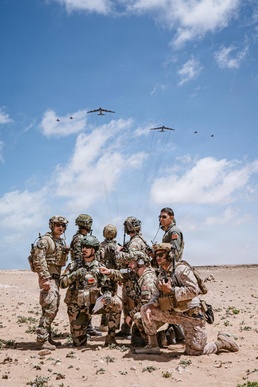
AGADIR, Morocco – A combined flight of two U.S. Air Force B-52H Stratofortress bombers and four Royal Moroccan Air Force F-16 Fighting Falcons over Cap Draa, signaled the launch of Morocco's first nationally accredited joint terminal attack controller qualification course, April 23.
The flyover was a key component of African Lion 26, U.S. Africa Command's largest annual joint exercise, led by U.S. Army Southern European Task Force, Africa (SETAF-AF) from April 20 to May 8. Integrating these aircraft into the multinational exercise demonstrated the ability of the U.S. and its partners to project combat-credible airpower worldwide.
Air Force Global Strike Command bombers routinely conduct sorties around the world to include flights required to maintain crew proficiency and qualification.
“Their visible presence over Morocco, operating alongside Royal Moroccan Air Force fighters, signals credible deterrence and reinforces the U.S. commitment to regional security,” said U.S. Air Force Gen. Dagvin Anderson, commanding general of U.S. Africa Command.
U.S. Strategic Command bomber forces regularly carry out combined theater security cooperation engagements with allies and partners, demonstrating the credibility and flexibility of U.S. forces to address today's complex, dynamic and unpredictable global security environment.
“The inaugural JTAC qualification course trains Moroccan students to direct combat aircraft, artillery and naval gunfire from forward positions,” said U.S. Air Force Master Sgt. Therron Bundick, chief of weapons and tactics for the 165th Air Support Operations Squadron. “These controllers hold the authority to clear airstrikes, ensuring accuracy while avoiding friendly fire and minimizing collateral damage.”
During the exercise, U.S. Air Force JTACs assigned to the 165th ASOS, as well as Detachment 1 of the 2nd ASOS, joined U.S. Marine Corps JTACs with the 3rd Air Naval Gunfire Liaison Company to train alongside service members from Canada, Hungary and Morocco. Live and simulated training events give students realistic close air support scenarios, and the diverse group accelerates the development of a professional JTAC cadre through the exchange of tactics and procedures.
The program marks a significant milestone in the development of the Moroccan joint fires capability and a foundational step toward a standardized, internationally interoperable JTAC capability aligned with modern coalition warfare requirements.
"Morocco's first JTAC qualification course marks a historic milestone in advancing allied interoperability," Bundick said. "U.S. involvement ensures a rigorous training environment to establish a lasting foundation for the program's future."
Combined live-fire integration also allows U.S. units to test their own tactics alongside trusted partners. U.S. Marine Corps Maj. Michael Chevallier, 1st Brigade air officer assigned to 3rd ANGLICO, emphasized that the training allowed both forces to cross-train and leverage each other’s unique operational capabilities.
"Combined live-fire training like this allows us to validate our tactics, techniques and procedures under the trusted scrutiny of an allied force," Chevallier said. "It reinforces that shared commitment to excellence where, as we say, 'steel sharpens steel.'"
Chevallier said AL26 has provided a valuable opportunity for the Marines of 3rd ANGLICO and its partners in the Royal Moroccan Armed Forces to learn from each other's strengths and unique capabilities.
The combined employment of U.S. strategic heavy bombers with Moroccan airpower, paired with the launch of Morocco's first nationally accredited JTAC qualification course, provides flexible options to assure partners and deter potential adversaries across the U.S. Africa Command area of responsibility.
About AL26: AL26 is U.S. Africa Command's largest annual joint exercise, designed to strengthen collective security capabilities of the U.S., African nations and global allies. Led by U.S. Army Southern European Task Force, Africa (SETAF-AF) from April 20 to May 8, and hosted in Ghana, Morocco, Senegal and Tunisia, AL26 involves over 5,600 civilian and military personnel from more than 40 nations, using innovation to drive partner-led regional security.