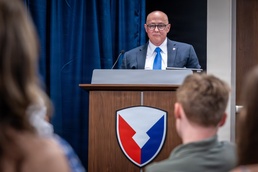
REDSTONE ARSENAL, Ala. – Army Materiel Command’s first chief data and analytics officer, Dr. Chris Hill, is retiring after a combined 40 years of military and federal civilian service.
His decades of service have made an indelible mark not only on the Army, but on every person he has served with – including me, his daughter. The least I could do as a public affairs specialist, whose mission is to tell the Army’s story, is to illustrate the impact he has had.
Hill grew up as an Army brat, born at Fort Sill, Oklahoma. His dad was a pilot who flew during two Vietnam War deployments and served as a flight instructor later in his career. He lived on military installations all over the world and spent his summers working on farms. His upbringing forged his path to service and would influence his interest in industrial operations.
“I saw the bonds military families had and saw everything installations had to offer,” Hill said.
At 17, he entered military service, spending a year in the Army Reserve and then the Alabama National Guard. He started as a Huey mechanic before becoming a cavalry scout, finding work with tanks more thrilling. He won an ROTC scholarship at Auburn University, went to ranger school as a cadet and later commissioned into the Armor branch.
My father spent 26 years on Active Duty. His career took him to the East German border when the Berlin Wall still stood, on a 13-month deployment to Afghanistan and a joint special operations task force assignment in the Philippines. It also took him back to school and on a journey he couldn’t have imagined.
Hill’s mentors steered him to operations research analysis, calling him a “natural problem solver.” He went back to school as a 30-year-old in freshman math, where young adults called him “Pops.” He thrived in this new field, completing his master’s degree at the University of Central Florida and competing for a billet to get his Ph.D. there. He got it and studied data mining and using big data sets – skills that, without a doubt, would come in handy later.
During this time, Hill was also raising me and my two siblings with our mom, Barbara. Despite the mental load, he was present and engaging. He played “hairdresser,” went to Disney World, had cannonball competitions at the pool and participated in school activities – all while balancing homework and studies.
When his coursework ended, he found himself moving to the National Capital Region and working through some of the Army’s biggest challenges. While at the Center for Army Analysis, he was the joint lead for the 2005 Base Realignment and Closure. The hours were long and the decisions were tough to make, but the analysis provided made lasting change for the Army. One result of the decisions and analysis from this team was the movement of AMC to Redstone Arsenal.
The final years of his military career involved long commutes, long hours and complex problems to solve, all while also being a dad and husband, helping with math homework, giving advice, coming home for family dinners, going to sporting events and spending meaningful quality time with his loved ones.
Retirement means different things for different people, and my dad’s Army story was not finished. He started his Army Civilian Career as the Director of the Army Materiel Systems Analysis Agency, establishing an analytics cell in AMC’s headquarters in 2012 under AMC Commander Gen. Dennis Via.
“Most of the generals were skeptical and didn’t know what operations research could do,” Hill said. “It didn’t take long for Gen. Via to figure out what we could do for him.”
Other leaders soon caught on. The next commander, Gen. Gus Perna, realigned AMSAA to report directly to him, rather than presenting findings to a board and other leaders before him. Hill would ask, “What is your hardest problem right now?” and he and his team would tackle it.
This is where my Army story takes shape. My understanding of the Army and love for it was a direct reflection of my dad’s passion. He gave me advice and talked to me about the benefits of civilian service, but none of us imagined I would end up at AMC, too, as a public affairs fellow. In fact, my dad didn’t even know I was hired until Perna congratulated him.
In the past eight years of working at AMC, I have finally realized the magnitude of the work my dad has done. I witnessed him and his team, rebranded to the AMC Analysis Group, taking on the hardest problems the Army faced.
While working for AMC Commander Gen. Ed Daly, he played instrumental role in Operation Allies Welcome. He and his team examined flow rates for Special Immigrant Visa applicants, looked at different parameters like country-specific laws, aircraft capacity and other factors. AMC provided transportation and temporary housing, sustainment and support in the United States for vulnerable Afghan nationals, their families and other at-risk individuals, sometimes with just an hour’s turnaround.
“You need us behind computers. That is where our superpower is,” Hill said.
In 2022, the AMCAG was directed to support 18th Airborne Corps in Europe. The AMCAG provided 2.5 years of support to allies and partners in Europe. During this time, Soldiers and Army Civilians in the AMCAG went on rotational deployments. They used predictive logistics to map what parts units needed before they were asked for. They developed a system to map equipment through transportation flows. They could forecast readiness of weapon systems and units and use data analytics to check if plans were logistically supportable.
“We were able to identify issues early, before they became a problem,” Hill said.
Now that he is rounding out his career with AMC Commander Lt. Gen. Chris Mohan, Hill is sharing his knowledge across the entire command.
“I think a lot of people don’t realize the power of artificial intelligence and what it can do for you. It will become central to everything we do,” Hill said.
As part of the command’s advanced analytics and artificial intelligence effort, or A3I, AMC established data leads in each headquarters staff section who will be responsible for integrating A3I into daily operations. Hill’s team trained and supported this new A3I staff, allowing data leads to automate processes, build tools and dashboards, and leverage artificial intelligence to streamline operations.
“You’re either green and growing or ripe and rotting. You can’t get to the point where you’re comfortable and not continuing your education. You have to continue developing your skills and evolving,” Hill said. “Developing people is the most important investment.”
In his Army Civilian career, Hill’s team has worked on high impact projects and shaped some of the Army’s biggest efforts. Hill provided support during four rounds of employee reductions to ensure the lowest risk. His analysis helped create the Facility Investment Plan and reform installation management. The AMCAG used to be made up of just six people. It is now a team of 38 with backgrounds ranging from math majors, industrial engineers, accountants and astro physicists. Hill was also the sounding board for five commanding generals and countless aides, staff and mentees.
“I think my legacy is that even in a place as complex as AMC, you have to take a structured approach to problem solving,” Hill said. “For problems at the speed and scale of what AMC faces, you have to go through structured problem solving.”
People have asked me, “what is the Army going to do without your dad?” Rest assured, my dad has built the bench and next generation of analysts throughout his career. He has inspired many and empowered people to do the impossible. The Army will keep rolling along, but largely because of the care and selfless service Hill has provided in his 40 years of service. I’ll miss my coworker, but I’m even more excited to see what’s ahead for my dad.