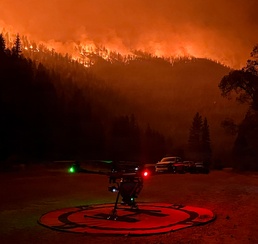
Drones, also referred to as uncrewed aerial systems or UAS, have been increasingly complicating airspace around wildfires since the first consumer models came to market in 2013.
These mechanical critters of the sky are a nuisance to wildland firefighting when they are operating unauthorized in restricted airspace, putting pilots, their crews, and aircraft at risk.
When unauthorized drones are sighted, the fire manager must shut down the airspace for all air operations supporting the wildland fire suppression for safety reasons. This means crucial aerial firefighting and lifesaving capabilities – like air medevac and fire suppression aircraft – can’t fly. People could die and more buildings and forest could burn when someone flies their unauthorized drone in restricted airspace.
In 2025, there were 218 drone sightings over active wildfires. Most of these occurred during last year’s Eaton and Palisades Fires in Los Angeles where 184 drone incursions were reported within the restricted airspace set up around the active fires.
While that might not seem like a large number, especially near one of the nation’s largest cities, it’s more than the seven-year national total of 125 reported incidents.
"We suspect the actual number of intrusions is likely higher, as detection can be limited by visibility and the availability of equipment,” said Lyndsay Johnson an assistant director of aviation safety for the Forest Service.
Shortly after a midair collision on Jan. 9, 2025, between a water-dropping aircraft called the Super Scooper and a small consumer drone, a counter UAS task force was formed with the FBI, and Los Angeles County Fire Department and Sheriff’s department.
“Counter UAS, is about detection and deterrence,” said Johnson. “They use a system to detect drones the second someone turns them on. They then can track the controller, the location of the operator and their flight profile.”4
That’s when an intercept team consisting of the sheriff’s department and the FBI go out to find the drone operator. During a one-day period on the Eaton and Palisades Fires, the intercept team conducted 49 detections and intercepts.
One of these visits from the FBI can come with tens of thousands of dollars in fines, and prison sentences up to 12 months.
The intentions of these drone pilots often fell into one of three categories – criminal, careless or clueless. Regardless of intention, flying drones in restricted areas has real consequences. Temporary flight restriction areas are supposed to provide aerial firefighting aircraft with a safe and secure airspace to operate. Each intrusion increases the likelihood of a midair collision.
Johnson has heard many stories of near misses, sometimes close enough for the pilots to count the propellers.
Dave Mundwiler, a lead plane pilot, and Jerry Serabia, air tactical supervisor, are very familiar with the added challenges unauthorized drones can bring. During a wildfire, it’s their job to fly a smaller lead plane guiding airtankers to drop their retardant.
While it may sound simple, there’s a lot going on in the airspace of one of these fires, which makes having two people and two sets of eyes essential. While Mundwiler flies the plane, Serabia is in constant communication with other aircraft in the area.
“During the Palisades fire, there were nine helicopters working right where we're dropping retardant with a rotation of about 10 airtankers. So, I’m coordinating with helicopters and other airtankers coming to and going off the fire,” said Serabia.
Mundwiler and Serabia’s goal is to assist the safe delivery of the needed gallons of water per hour to an active wildfire. To do this, pilots must fly low and fast just above the fire. Unauthorized aircraft, such as drones, make this even more dangerous.
“I’m on the lookout for other aircraft, anything that might impact us or be a problem. We're going about 150 miles per hour. So just imagine hitting anything at 150 miles per hour. If you hit an insect holding your hand out the window at 150 miles an hour, it would probably puncture your hand.”
The potential damage done from a drone strike can vary. It could hit the tail of the plane making the aircraft difficult or impossible to control. It could go down an intake and disable an engine. It could go through the windscreen and hit the pilot or copilot and directly injure or even kill them.
While working to suppress fires in Southern California, they have seen a few drones in their immediate area and almost hit one. Scenarios like these can pause firefighting operations for up to 15 minutes.
“[Pausing aerial operations is] never something pilots want to do, but the added risk to the pilot, the crew and the aircraft makes it a losing compromise.” said Mundwiler.
Pilots cannot see unauthorized drones on their instruments or through the cockpit windows.
“Have you ever almost hit a bird in your car when you're driving down the road? Do you always see it coming or does it flash in front of you? That's exactly what it's like in an airplane. You just don't see them until it's right in front of you.”
Drones weren’t much of an issue when Mundwiler started flying 23 years ago. The first consumer drones were still years from market.
“Now it's more common than not, especially in the wildland urban interface, to have drone sightings at some point during the incident.”
These drones are an ever increasing risk to firefighters and the communities and forests they work to protect.
That’s why we ask the public to please refrain from flying personal and commercial drones in near wildfires, which is restricted airspace. Flying a drone in restricted airspace (PDF, 437 KB) around wildfires is a federal crime, punishable by up to 12 months in prison and a civil penalty of up to $20,000.
Let’s keep our fire crews safe.
Learn more about how the Forest Service applies Unmanned Aircraft Systems (UAS) technologies to further our ability to support the agency’s mission.