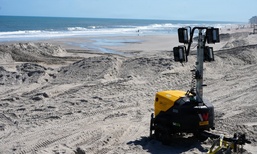
CAROLINA BEACH, N.C. — With the placement of nearly 2 million cubic yards of sand across approximately six miles of shoreline now complete, the U.S. Army Corps of Engineers, Wilmington District, has strengthened coastal storm protection and restored a wider, more resilient beach at Carolina and Kure beaches. The project has now transitioned into its final phase as contractors remove pipeline and equipment from the shoreline.
The contractor, Norfolk Dredging Company, completed sand placement at Kure Beach and immediately began demobilization. Crews are expected to continue removing equipment through approximately mid-May, weather and conditions permitting. Demobilization is often one of the most visible phases for the public, as equipment used during dredging operations is dismantled and transported off the beach.
Visitors to Carolina and Kure beaches may continue to see crews working along the shoreline as sections of pipe are disassembled and removed. Equipment currently extends from the Carolina Beach Inlet through Kure Beach, with multiple crews operating simultaneously across the project area to expedite removal.
Work is taking place at several key access points, including Freeman Park, Davis Avenue, Hamlet Avenue and Ocean Boulevard. Temporary impacts, such as limited access or short-term closures, may occur as equipment is removed. Freeman Park, for example, is periodically closed to support the removal of booster equipment used during sand placement operations.
As demobilization continues, the beach will begin to take on a more natural appearance. Newly placed sand is typically wider, flatter and more uniform than a naturally weathered shoreline. Over time, wind, waves and tides will reshape the beach into a more familiar slope and profile. Most visitors can expect the beach to feel more natural in the weeks following completion, as these processes gradually reshape the shoreline.
“Beach renourishment is one of the most effective tools we have to reduce storm risk for coastal communities,” said Kent Tranter, project manager with the Wilmington District. “By widening the beach, we’re creating a buffer that helps absorb wave energy and protect homes, infrastructure and public spaces during storm events.”
The newly widened shoreline now serves as a protective buffer for the community, helping reduce the impacts of storm surge and wave energy on homes, infrastructure and public spaces. In addition to storm risk reduction, the project supports recreation and tourism by providing increased space for residents and visitors to enjoy the beach.
While the most visible work is now focused on removing equipment, Tranter said the success of the project reflects extensive planning and coordination behind the scenes.
“There’s a lot happening behind the scenes—from environmental compliance to engineering design and coordination with our partners,” Tranter said. “Every step is carefully managed to ensure we’re placing the right material in the right location to maximize long-term benefits.”
Officials encourage the public to remain aware of active work areas during demobilization and to follow posted guidance until all equipment has been removed.
The project represents another phase in the U.S. Army Corps of Engineers’ ongoing partnership with local communities to strengthen coastal resilience along North Carolina’s coastline.