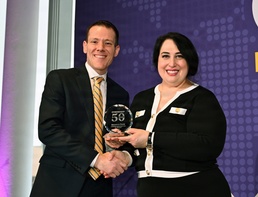
WASHINGTON — This past winter, the Army’s Principal Cyber Advisor https://cyberscoop.com/2025-cyberscoop-50-award-winners/. The award, presented by Goldy Kamali, CEO of Scoop News Group, is described as the event’s most prestigious award within the annual CyberScoop 50 Awards, recognizing leaders who have made the most significant impact across the entire cyber sector. Upon receiving the award, Pugh expressed his appreciation.
“I am deeply humbled and grateful to receive this award, and I want to extend my sincere thanks to CyberScoop and to everyone who voted.” Pugh said. “I also want to thank President Donald Trump and Secretary of the Army Dan Driscoll for giving me the opportunity to serve the Army and the nation. This recognition is a testament to the incredible work being done by the entire Army cyber team, and I am proud to accept it on their behalf.”
Before receiving the award, Pugh participated in CyberScoop’s CyberTalks panel discussion titled “Cyber Plans from the Services," moderated by Billy Mitchell, senior vice president and executive editor of Scoop News Group. The discussion featured Pugh alongside Anne Marie Schumann, principal cyber advisor for the Department of the Navy; Dr. Wanda Jones-Heath, principal cyber advisor for the Department of the Air Force; and Dave Galoppo, senior director for full spectrum cyber at General Dynamic Information Technology.
During the panel, Pugh elaborated on the Army’s priorities, noting that cyber is a key element of the Army’s Continuous Transformation effort to prepare for future conflicts. Pugh highlighted that out of five key investment areas identified for the Army by the Secretary of War Pete Hegseth, his office leads two of them: cyber and electronic warfare.
“I think it’s essential to see cyber in two ways,” Pugh commented during the panel. “How can it be a standalone capability? There might be times where we want to leverage cyber for defense or offense, but how is it also enabling traditional military activities like kinetic effects?”
Pugh stressed the importance of shifting beyond a legacy mindset and integrating cyber capabilities across Army operations, a sentiment echoed by his fellow panelists. He also highlighted the critical importance of protecting the Army's camps, posts and stations to ensure both homeland defense and the ability to project forces globally.