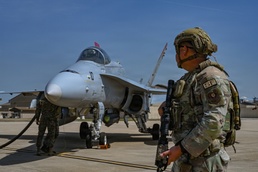
KUNSAN AIR BASE, Republic of Korea — U.S. Air Force Airmen assigned to the 31st Combat Air Base Squadron established a contingency location at Kunsan Air Base to support joint air operations during exercise Freedom Flag 26-1, providing a platform for agile combat airpower in a dynamic environment.
The squadron deployed personnel and equipment to enable refueling and provide aircraft security for a U.S. Marine Corps Marine Fighter Attack Squadron (VMFA) 232 F/A-18 Hornet and a U.S. Air Force KC-135 Stratotanker assigned to the 909th Aerial Refueling Squadron. The effort proved a continuous airpower generation scheme of maneuver designed to increase survivability against potential threats.
“In real-world scenarios, we’re going to be asked to do this regularly,” said 31 CABS non-commissioned officer in charge of expeditionary logistics. “This is exactly what our unit is built to provide—forward capability outside of a main operating base, anytime and anywhere.”
As part of the setup, 31 CABS Airmen established a tactical operations center and integrated communications systems to coordinate mission activities throughout the exercise. The TOC served as the central hub for command and control, allowing leaders to maintain situational awareness, direct resources and synchronize operations between air and ground elements in real time.
Fuels management specialists sustained the mission by rapidly establishing forward refueling capabilities. Under expeditionary conditions, they enabled the success of both KC-135 and F/A-18 missions and accomplished training objectives in preparation for future taskings.
“Exercising agile combat employment allows commanders to operate tankers from austere locations with minimal maintenance support,” said Capt. Luke Osburn, 909 ARS assistant chief of training. “That flexibility gives them more options to employ airpower effectively.”
Security forces Airmen were equally essential to the operation, implementing layered defense measures to protect personnel, aircraft and critical resources. Airmen from the 51st Combat Communications Squadron worked behind the scenes to ensure seamless operations, maintaining equipment and enabling secure communication capabilities essential for the contingency location as well as the success of Freedom Flag overall.
“Establishing a forward edge command and control headquarters expands the commander’s situational understanding of the battle space," said U.S. Air Force Col. Brad Dvorak, commander of the 31st Air Expeditionary Wing. “The potential for missions beyond refueling will be further analyzed in the 31 AEW.”
Freedom Flag 26-1 is a large-scale, combined training event designed to strengthen interoperability between U.S. and Republic of Korea forces. This large-scale employment training enhances U.S. and ROK interoperability and ultimately enhances U.S. and ROK commitments to ensure security, freedom and prosperity for the U.S., our allies and partners.