EL SEGUNDO, Calif. — Much like the diverse languages of the world, U.S. military services often navigate using different languages unique to their organizations, domains, and capabilities. However, the demand for multi-domain integration requires the convergence of services through joint-centered approaches to deliver the fortified and proliferated operations across every domain that maintains decisive advantage for the Nation.
Recognizing the U.S. Space Force’s role as the lynchpin to every domain, Space Systems Command (SSC) is pursuing joint-focused curriculum and workforce development within its Year of Readiness initiative to posture Guardians to meet that demand head on. Leading the field command in that charge is SSC’s Operations and Readiness Directorate (SSC S3/7).
“Joint-focused development is the key to turning Guardians into warfighters who are fluent across domains, ready to integrate, and capable of delivering immediate combat value,” said U.S. Air Force Col. Timothy Paget, SSC director of Operations and Readiness. “We need personnel who can step into the joint fight, understand the mission instantly, and execute without delay. That level of readiness doesn’t happen by chance, which is why we are placing such an emphasis on building joint training opportunities across SSC.”
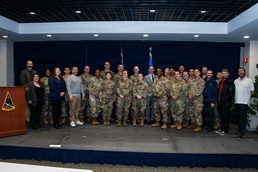
In its first Year of Readiness opportunity for development, SSC S3/7 recently partnered with Space Training and Readiness Command’s (STARCOM) National Security Space Institute (NSSI) to host a Joint Planning Process (JPP) course for 38 SSC Guardians, including officers and civilians from Los Angeles Air Force Base (AFB), Calif, Vandenberg Space Force Base (SFB), Calif., Cape Canaveral Space Force Station, Fla., and Hanscom AFB, Mass.
“The Space Force was built to integrate with the joint force, and that’s how we operate every day,” said Paget. “This course empowers Guardians to take joint principles from theoretical knowledge into their day-to-day operations, which in turn deliver real-world impacts leading to space superiority.”
SSC’s action officer for this development opportunity, USAF Capt. Vincent Nguyen from SSC S3/7’s Future Operations Division, noted that these courses help shape our space acquisitions workforce and their ability to speak the Joint Force common language to navigate effectively across domains and services.
“As we progress in our careers, it’s important to broaden our perspective and skills,” Nguyen said. “Cross-functional coordination skills are critical. Not only are we going into the joint fight to speak the same language, but it also gives us the knowledge to educate other services on what the Space Force brings to the fight.”
USSF Capt. Insan Jang, chief of System Delta 831’s (SYD 831) Global Positioning System (GPS) Management Office, shared that he pursued participation in the course following participation in a bilateral exercise in the Indo-Pacific area of responsibility where he was further exposed to Operational Plans (OPLANs) and the Space Service Request process within the exercise scenario.
“I [previously] attended Ulchi Freedom Shield exercise in the Republic of Korea, where I learned about OPLAN and Space Service Request processes during a wartime scenario,” Jang said. “The biggest takeaway [of the course] was seeing how the space capabilities are used… to have that viewpoint and see the responsibilities of various organizations, and to see the command-and-control process from the request to execution.”
USSF 1st Lt. Amy Padilla, the SSC Intelligence Directorate’s (SSC/S2) branch chief for Intel Plans and Programs, shared that she attended the course to expand her capabilities within her current role.
“Space is an inherently joint domain, and we are still very much in the process of integrating into joint planning and policy overall,” Padilla said. “Attending courses like this helps me better advocate for SSC and the Space Force.”
Padilla noted that the curriculum not only aids in her advocacy of the service’s role within the joint force but also contextualized the scope of its support.
“Understanding the structure of an OPLAN has been essential to understanding USSF’s role in recent campaigns,” Padilla said. “And from an intel perspective, this course helped contextualize a lot of what we do as far as reporting on commanders’ priorities.”
Nguyen added that the capacity for the 38 participants to dedicate time and availability comes as the result of commanders recognizing and prioritizing the importance of a joint-enabled workforce.
“It’s not lost on SSC S3/7 that the ability to focus on curriculum and development requires a member to be unavailable to mission support, and in the high-tempo world of SSC, that can generate a manning gap even for a small window of time,” Nguyen said. “We sincerely appreciate commanders and leaders from across the command prioritizing development opportunities like this.”
As SSC S3/7 continues to lead the field command’s focus on this Year of Readiness, they will continue to synchronize efforts across personnel, capabilities, and operations to organize, train, and equip our warfighters in a way that achieves and sustains a high state of military readiness.
“Readiness is a holistic endeavor, requiring Guardians to be individually and operationally prepared across all facets,” said Paget. “As the USSF’s acquisition engine, our role is to deliver the critical capabilities our joint warfighters rely on and equip Guardians more effectively for today's missions and the challenges that lie ahead.”
SSC S3/7 aims to continue additional development opportunities for Guardians focusing on future course availability at varying locations across SSC. SSC S3/7 encourages SSC’s military, civilian, and contracted personnel to stay open for upcoming development as the year progresses.