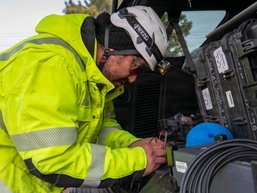
Every time an Airman on base takes a drink of water, washes their hands, or sees a fire truck race to an emergency, they are relying on a silent, unseen system.Ensuring this system can provide water to Airmen, their families and the mission is a constant critical project for the 92nd Civil Engineer Squadron.
Fairchild’s main water supply collects from multiple off-site sources and converges at a water treatment facility reservoir. From there, it travels several miles through underground concrete-lined steel piping to the on-base water treatment facility for further purification.
This year, the 92nd CES water and fuels system maintenance flight worked with Xylem Water Solutions and Technology to detect potential leaks, gas pockets and pipe wall distress within Fairchild’s water transmission lines through cutting-edge technology like SmartBall and PipeDiver.
“Technologies like this enable the 92nd CES to make informed decisions about future projects that affect the Fairchild mission,” said 2nd Lt. Grant Trembley, 92nd CES water and facility treatment project manager. “This information ensures that every project we commit to is an intentional response to a known requirement rather than a reaction to the unknown."
Utility maintenance can rely heavily on the age of the infrastructure, which can lead to expensive, disruptive excavations to replace entire pipelines that may still be structurally sound. Shifting to a condition-based assessment model can help eliminate guesswork. This proactive approach allows engineers to surgically target sections of the pipeline that could potentially fail in the future, preserving resources for other critical base requirements. Furthermore, because these advanced tools operate inside fully pressurized pipes, the base avoids massive water outages, ensuring flightline operations, medical facilities, and base housing experience zero disruptions during the inspection process.
According to Xylem, SmartBall is a free-swimming inspection tool that resembles a small racquetball placed inside of a larger foam housing. It can be deployed in pressurized pipelines without the need to depressurize the line and interrupt water transmission. SmartBall uses a highly sensitive acoustic sensor that can detect pinhole-sized leaks and identify the sound of trapped gas and indicate their locations typically within 6 feet as it rolls along the bottom of a pipe. Utilizing the latest accelerometer and gyroscope technologies, advanced location algorithms and field-collected global position system points, the SmartBall can map X and Y coordinates of the entire pipeline.
PipeDiver is also a free-swimming inspection tool but is designed to better assess the overall structural integrity of a pipeline through electromagnetic and ultrasonic technologies, according to Xylem. The body of this tool resembles a modular mechanical eel with descending layers of large, flexible flower petal-shaped fins that allow the PipeDiver to bend and articulate itself through various twists and turns inside of pipelines. Unlike SmartBall, the PipeDiver swims through the center of the water column ensuring the electromagnetic sensors scan equidistant from the pipeline walls providing the most accurate data.
“These technologies identify invisible threats before they become catastrophic failures, impacting mission success,” said Trembley. “By using data obtained from the SmartBall and PipeDiver, the 92nd CES can ensure Fairchild AFB’s waterline infrastructure remains reliable to provide Airmen, their families and the mission the assurance required to for uninterrupted mission execution.”