Standing Where Others Fell
In the summer of 2025, Cadet Amani Haskins and a group of fellow West Point cadets stood at a monument in the French countryside – the sister monument of one they had seen only weeks before in Harlem, New York. Same stone. Same shape. Same names. An ocean apart.
Haskins explained, “I got to stand at the 93rd Division monument [in France] and explain the impact” of American soldiers in World War I. The recognition of the 372nd Infantry Regiment of the 93rd Infantry Division via this memorial was human before it was tactical: Haskins and her peers discovered that war reaches farther than its battlefields, and understanding that reach is part of what makes a great leader.
This is why the study of history belongs at the center of officer education, not its margins. When modern day warfighters are grounded in the ways that warfighting culture is created and, as Haskins says, “how every individual, whether they were fighting in the war, on the home front, or in the villages and farms of France, had a massive impact on [the culture] we understand of the past now” to inform our warfighting future.
Multiple Lenses, Informed Judgement
There is a temptation to treat history as a delivery mechanism for tactical lessons. The Great War resists that temptation because, according to Cadet Reese Bell, “World War I is arguably the most perplexing and consequential conflict in human history.” It does not fit a single tactical, operational, or strategic frame.
At West Point, cadets encounter WWI not in one course, but across many. These include HI302 (The History of Military Art 1900 – Present), HI344 (Modern Diplomacy), HI355 (Warfare, Industry, and Empire), HI399 (History Staff Ride), and more. Each course’s lens reveals something the others cannot; together, they produce something more valuable than simple knowledge, they produce informed judgement rooted in cultural understanding.
Where We Fit
Cadet Joah Miller, completing a senior thesis on junior officers in the American Expeditionary Forces, described why World War I resists singularity: “The war in 1918 is not the same war as 1914 or 1916 or even 1917. So then for me, my question was: how would newly-minted junior officers be able to fight when they were coming into a war in 1918… [that exposed] gaps and challenges in their training and in their leadership.”
His thesis focuses on the lieutenants who closed those gaps through improvisation. Those junior officers were not taught to do everything that was needed – they figured it out. As Cadet Haskins echoed, learning the tactics, operations, and strategies of World War I illuminated insights into “how to play [her] role and understand where [she fits] on the battlefield… whether a barrage, hold[ing] off the enemy, or open[ing] a corridor for mobility.” For two cadets about to commission as Field Artillery officers in today’s Army, learning The Great War is not historical curiosity, it’s a mirror.
The War We Keep Returning To
World War I is over a century old. As Cadets Bell and Haskins saw firsthand in France, “all the farmland has obviously been reclaimed and reused, and there aren't still trenches and trench systems in the middle of northern France” (Bell). The land has regenerated. The armies have long disbanded. And yet, The Great War keeps reasserting itself in debates over artillery modernization, in questions of coalition warfare, in the challenge of doctrine trailing technology, and in the strain of mobilization on training and leadership.
The cadets who study World War I most deeply do not emerge with a set of facts. They emerge with a set of questions about adaptation, about the gap between policy and execution, and about what happens when those gaps are not closed. Those questions will be asked again, in different forms, in every conflict these soon-to-be officers will encounter.
The Great War does not offer easy answers, it offers something better: the habit of asking the critical, right, and historically informed questions before war begins. Studying World War I across contexts creates cadets who become great warfighters with a strong sense of informed judgement rooted in our past, but looking out across our future.
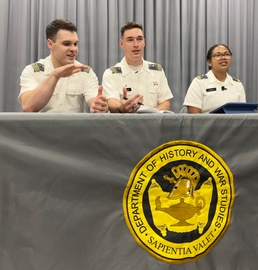
The WWI and Modern Warfare team is part of the Department of History and War Studies’s presentation at West Point's 27th annual Projects Day Research Symposium, which showcases hundreds of cadet-led research projects. Learn more about this year’s select project features and how to partner with West Point at www.westpoint.edu/werx. You can also learn more about WWI and other wars through West Point Digital History Center’s atlases.