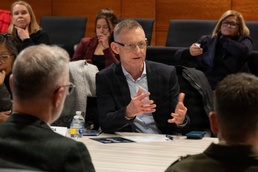
The Ted Stevens Center for Arctic Security Studies convened senior leaders and subject matter experts from across Joint Base Elmendorf-Richardson for a focused briefing to the Standing Committee of Arctic Parliamentarians (SCPAR) on strengthening Arctic capability, enhancing allied interoperability, and advancing integrated approaches to security in the region.
The briefing included participation from U.S. Senator Lisa Murkowski, U.S. Senator Peter Welch, Lt. Gen. Robert Davis, the Commander of Alaskan Command, Alaskan North American Aerospace Defense Command Region, and Eleventh Air Force, Maj. Gen. John Cogbill, Commanding General of the 11th Airborne Division, and Brig. Gen. Brian Kile, Deputy Adjutant General of the Alaska National Guard.
Discussions centered on the evolving Arctic operating environment and the increasing need for coordinated, multinational approaches to ensure readiness across the region. Presenters emphasized that Arctic capability now requires integrated approaches across domains, strengthened partnerships, and sustained investment in people, systems, and infrastructure.
Key topics included the importance of integrated domain awareness, the development of resilient and dual-use infrastructure, and the expansion of allied interoperability through combined planning, exercises, and shared operational frameworks. Participants underscored that these capabilities are essential to ensuring effective coordination among Arctic and allied nations in a region of growing strategic importance.
Ted Stevens Center Deputy Director, Craig Fleener, focused on the role of education in building Arctic expertise. He highlighted the Center’s ongoing educational programs designed to develop Arctic-literate leaders, strengthen professional networks, and build shared understanding across partner nations. These programs were reinforced as critical to ensuring that current and future decision-makers are prepared to operate effectively in Arctic conditions.
Speakers noted that as activity in the region increases, success will depend not only on platforms and infrastructure, but also on the ability of allied and partner nations to develop common approaches and build enduring relationships.
The briefing reinforced the importance of continued collaboration between legislative leaders, military organizations, and Arctic-focused institutions to ensure sustained progress in building capability and readiness across the region.