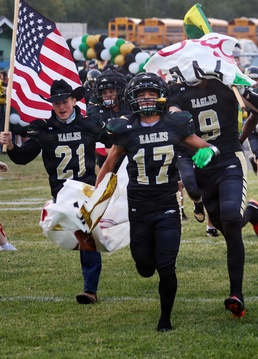
FORT KNOX, Ky. — Robert Magalong loves the start of a new football season:
The fresh smell of trimmed turf and line paint; the buzz of large stadium lights spotlighting every play; the sharp shouts of cheerleaders keeping time with a raucous marching band as noisy fans urge the team to victory – but most of all, the shrill screech of the referee’s kickoff whistle to start a new game.
The 2026 football season will be extra special for Robert – it’ll kick off at the U.S. Military Academy after he graduates from Fort Knox High School in May, where he’s hoping to play middle linebacker for the Black Knights.
“Everything has lined up well for me,” said Robert, who has an appointment to West Point, New York, where he will pursue a bachelor’s degree in kinesiology and receive a commission in the U.S. Army.
His parents, mom Elizabeth and dad Sgt. 1st Class Ronald Magalong, said they couldn’t be prouder and are looking forward to yelling “Go Army, Beat Navy!” during the 127th Army-Navy rivalry game on Dec. 12. Robert admitted he will be doing the same, whether on the sidelines at MetLife Stadium or on the field: “Why yes I will!”
When he wears his Dress Grays for the first time, Robert will also be bringing with him a long family legacy of Army service to the nation.
“I have a great military background: all the people I know, and my military relatives, my great grandfathers, my grandfather, my dad,” said Robert. “They have all been pushing me to build up the military skills I’ll need to get through the academy.”
Ronald, who works at Fort Knox’s 84th Training Command, said when his son receives the traditional Dress Gray uniform, he will fill it with a rich military heritage that dates to the start of World War II.
That heritage began with his great grandfathers, Felix Magalong Sr., and Ricardo Ebia Sr.
A Filipino Soldier from Pangasinan, Felix assisted the U.S. Army as a scout in 1941 at the age of 23 and was serving on the Philippine peninsula of Bataan in April 1942 when the unit he was attached to was captured and the commanding general surrendered to the Japanese army.
Felix was forced to walk every step of the now famous Bataan Death March alongside American Soldiers and endure captivity at Camp O’Donnell until he and the remaining prisoners were liberated at the end of 1942. He lived to talk about the experience, write about it, and reflect on memories of his own family during the ordeal.
“I thought of my loved ones, especially my asthmatic mother whose love and sacrifices for me I vividly remember. I thought of my father who also had asthma and who could no longer farm and catch fish. I thought of my sister, Carmen, who sacrificed immensely for me by obtaining a job as a housemaid that I might complete my high school education,” Felix wrote later. “I felt helpless and frustrated and a thought came to me several times, that it would have been better to die in Bataan so my parents would benefit from my pension that they would receive.”
Following his release, Felix was transported to Fitzsimmons Army Garrison in Colorado to heal from his wounds. While there he was given the opportunity to join the U.S. Army, which gave him the opportunity to bring his family with him. His service also afforded him the opportunity to earn a master’s degree.
Felix continued to serve in the U.S. Army, including fighting in the Korean War, reaching the rank of captain by the time he retired in 1971.
Robert’s other great grandfather, Ricardo Ebia from Hawaii, joined the Army in 1944. He later served in the 169th Engineer Battalion during the Korean War and reached the rank of command sergeant major before retiring 42 years after he had enlisted.
Romeo Magalong, Ronald’s father, served in the U.S. Army Reserves starting in Colorado, also as an engineer. It was a transfer to Hawaii, however, that changed the course of his life. While assigned to 411th Engineer Battalion there, he caught the eye of his first sergeant’s daughter – and maybe 1st Sgt. Ebia’s ire for a brief minute.
Like his father and father-in-law before him, Romeo also made a career in the Army, reaching the rank of staff sergeant by the time of his retirement.
Ronald said his father also saw combat, during the Vietnam War. And like his father, Romeo put himself through school, earning a bachelor’s degree in civil engineering, which he would put to good use throughout the Rocky Mountain Region of the National Park Service for 30 years afterward.
Both families’ Army legacies never faded from conversations and stories around the dinner table and during day-to-day living.
“Growing up, my dad and I had an awesome relationship, and I was always so proud of all the things he had done,” said Ronald. “But my own decision to join the military came from many of my friends who were looking forward to joining once they graduated high school.”
Ronald said while living in Lakewood, Colorado, many in the community were military-oriented, so it was natural for him to also gravitate toward it. That’s when he learned about the passion his family had for the Army.
Ronald decided to enlist in the U.S. Navy.
“When I signed up, I went home and told my dad, and my dad said, ‘Well, we’re going to have to have a meeting with your grandparents,” said Ronald. “I turned around and said, ‘Umm, okay’ because I had talked to a Navy recruiter and was looking at the Navy SEALS.”
The meeting took place at Grandpa Felix’s house. Grandpa Ricardo just happened to be visiting them at the time.
“There were both of my grandparents (Felix and Ricardo) there, my dad, my two uncles,” said Ronald— “and they all started off with introductions on serving in the Army, or having served in the Army; they had all served in the Army.”
Ronald’s grandfather Ebia wasted no time getting to the point: “’So, why are you talking to the Navy?’
“I said, ‘Well—’ and he goes, ‘Is it because they’ve got boats? The Army has boats,’” Ronald recalled. “I said, ‘Well, I was thinking—’ and he said, ‘Well, that’s part of your problem; you don’t need to think, you just need to act.’”
All the men then expressed their admiration for Ronald’s decision, explaining to him that he was the only one of their grandkids at that time to take an interest in the military.
“So, the next month when I went down to the [Military Entrance Processing Station] to do all my testing and the physical, they thought I was going to be rolling in with the Navy people,” said Ronald. “The next thing they know, I’m going in through the Army line, and I’m getting these scowls from the MEPS people.”
Ronald said he chose the infantry originally as his military occupational specialty but later switched to the medical field. Nobody from his generation followed him in.
“For a long time, I thought I was going to be the last one because neither my brother nor any of my sisters, cousins or anybody was going into the military,” Ronald said. “I contemplated it, wondering if I should make it a career.”
Throughout his early years in the military, Grandpa Ebia would sometimes urge him to become a commissioned officer.
“Being that stubborn, hard-headed kid, I would be like, “No, grandpa, I want to be just like you. You’re a command sergeant major,” said Ronald. “He would say, ‘No, you’re a knucklehead.’”
Both of Robert’s siblings pursued service at a military academy, said Ronald. His brother attended the Public Safety Academy in Fairfield, California, and his sister attended the Utah Military Academy in Riverdale, Utah. She also applied to both West Point and the U.S. Air Force Academy before pursuing a degree in college.
Robert, the youngest of Ronald and Liz’s children, has decided that West Point will be the best fit for what he wants to accomplish, even though Ronald had suggested that he joins the Air Force.
Ronald said he thought Robert decided to pursue West Point because he was trying to outdo his two older siblings’ accomplishments. Robert said his decision was inspired more by his Army lineage and his mother’s advice.
“My mom always said, ‘If you’re going to go into anything military, become an officer, whether through ROTC or an academy.’ That was always my goal too,” said Robert. “I see what my dad has gone through as enlisted, and I want to be able to help Soldiers like him.”