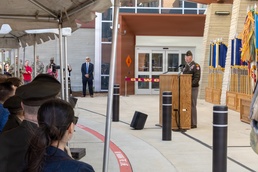
After six years of construction and much excitement among the community it serves, the opening of the new General Leonard Wood Community Hospital was celebrated with a ribbon cutting ceremony on March 31, 2026, bringing partners from across the region together to mark the important event.
Drawing a large and enthusiastic crowd to the event, the ceremony marked off a milestone for the project, which provides a much needed and highly anticipated modern healthcare facility for the military community in and around Fort Leonard Wood, in Pulsaki County, Missouri.
The new hospital features modern inpatient and outpatient care services, energy-efficient systems and advanced diagnostic imaging and surgical suites. The state-of-the-art facility also provides a healing environment, designed with patient comfort in mind.
The Kansas City District, U.S. Army Corps of Engineers managed the project with JE Dunn Construction as the design-build contractor and RLF Architects as the designer. In 2019, construction on the new hospital began with the creation of the temporary helipad, with major construction being completed in November 2025.
Steven Lanni, the program manager for the district who was tasked with overseeing construction of the hospital, heralded the partnership effort between multiple entities that enabled the project to be successful.
“The number one item that contributed to the success of this project was the partnership that was established with JE Dunn and the Defense Health Agency from the very beginning,” said Lanni. “This established a team built on trust and ensured all sides were transparent when issues arose.”
“I'd say we are a leader in the industry on partnering—collaborative analytics,” said David Manka, chief of Construction Division for the Kansas City District. “Initially, there were three or four projects within USACE actively utilizing collaborative analytics, and our district had two of those four projects.”
Collaborative analytics enhances team collaboration using feedback gathered through monthly surveys — which measure how all project stakeholders feel throughout the month to identify potential trends and unseen issues that may arise going forward. It can visualize the data using a red, amber, green system to flag areas of friction between parties and allows leadership to address any underlying problems before they negatively impact team dynamics.
The example Lanni gave was when the team uncovered a large sinkhole early in the construction phase. Having the ability to see the problem early allowed the team solve the problem in real time without causing a lengthy delay.
Manka said collaborative analytics facilitated a speedy resolution to the sink hole problem and squashed finger pointing among the partners.
“The team at Fort Leonard Wood worked incredibly well together and was open to the partnering concept and collaborative analytics and tried very hard to make things work,” Manka said.
The new hospital replaces the existing one which was built in 1965 and was one of the oldest hospitals in the Army’s inventory.
“As a retired Engineer Officer, Fort Leonard Wood is a second home to me,” said Lanni. “My wife and I have been stationed here three times throughout our careers and have spent a bit of time in GLWCH.We know firsthand the efforts the staff at GLWCH took to execute their mission smoothly.Being able to provide soldiers, sailors, airmen, marines and guardians a world class health facility brings me satisfaction that I am helping to provide for our future leaders.”
Brig. Gen. William Hannan Jr., commander of the Northwestern Division, U.S. Army Corps of Engineers, was one of five officials to provide remarks on the monumental moment for USACE and the nation.
“I had the unique opportunity of commanding the Kansas City District when this project started,” said Hannan. “So to be able to have that opportunity to come back now as the division commander, to see the ribbon cut, is really, truly special for me.”
He also recounted being stationed at Fort Leonard Wood during a time when his wife was pregnant and experiencing some difficulties that required emergency medical care. He understands first-hand the importance of the facility within the community.
“Being able to provide this facility to Army service members, to family members and retirees—to know they are going to receive help in a place that's welcoming in a time of need, I’m pretty proud of that,” said Manka.
There are three projects remaining to be completed on the program. Once the GLWCH team moves completely out of the old facility, the hospital residence office will oversee the demolition of the old facility which is the largest of the remaining projects and expected to be completed late 2028. A new parking lot will take its place and will be complete by 2030.