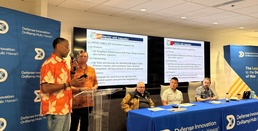
HONOLULU, Hawaii – The U.S. Indo-Pacific Command (USINDOPACOM) outlined its plans for expanding technology adoption and strengthening industry collaboration during its Quarterly Commercial Industry Update on March 13. The event, hosted by USINDOPACOM J7 Pacific Multi-Domain Training and Experimentation Capability (PMTEC) and the Defense Innovation OnRamp Hub: Hawaii, a program of the Defense Innovation Unit, connected military leaders with industry representatives to outline a path toward a more integrated, all-domain training and operations ecosystem in the region.
As the lead for joint training and exercises, USINDOPACOM J7 plays a critical role in shaping the command’s approach to modern warfare. By leveraging cutting-edge technologies and fostering industry collaboration, J7 ensures that the joint force remains ready to address emerging challenges in the Indo-Pacific. The J7 Directorate oversees initiatives like PMTEC, which is central to creating a persistent, theater-wide multi-domain training ecosystem.
Dr. Andre Stridiron, PMTEC program manager, described the initiative's progress in developing what he termed the "Pacific Impact Zone" – a network of training facilities and technologies spanning the Indo-Pacific region. The program aims to integrate space capabilities, cyber operations, other non-kinetic capabilities, and special operations forces into regular training exercises.
"We're building on the successes of the last two years to create a persistent, theater-wide multi-domain training ecosystem," Stridiron said. He highlighted the upcoming Valiant Shield 26 exercise as a key milestone and announced a new research partnership with Johns Hopkins University focused on artificial intelligence and digital twin technologies.
PMTEC, under the leadership of J7, addresses a practical challenge: the Pacific Ocean covers more than 60 million square miles, making traditional joint training exercises in the Indo-Pacific region logistically complex and expensive. By connecting geographically dispersed ranges through virtual and simulated environments, and harnessing the latest technology, forces can train together more frequently without extensive travel.
PMTEC’s quarterly industry meeting included updates from recent training events that demonstrated both progress and remaining challenges. Dave Bednarcik, PMTEC's range and targets program manager, discussed Exercise Cobra Gold 2026 (February 24 - March 6), a joint exercise with Thai forces that practiced Combined Joint All-Domain Operations (CJADO) – coordinating actions across land, sea, air, space, and cyber domains. This year’s iteration included a number of firsts, including the exercise’s first successful bilateral common operating picture (COP) for CJADO, made possible by digital architecture that synched and translated satellite, radio, and other communications with specialized equipment that provided continuous, secure connectivity even during rapid movement and in remote, austere environments.
Despite such technological achievements, gaps remain in creating fully realistic training environments. Bednarcik identified a specific need for industry support in developing more realistic training targets.
Mary Ann Swendsen, PMTEC's experimentation integrator, said industry support is also needed to develop capabilities aligned with the Department of War's AI strategy. She shared lessons learned from recent exercises, particularly regarding operational security in digital environments. According to Swendsen, the exercises successfully tested simulated information environments and digital twin technology, and industry plays a key role in further developing foundational enablers.
Significant warfighting enablers also include space and cyber capabilities. PMTEC Space Integrator Andy Emslie and Director, Space Development Agency Pacific, Daniel Hannah, detailed efforts to integrate capabilities such as electronic warfare and missile warning systems into exercises. They identified the Space Development Agency's Proliferated Warfighter Space Architecture as a key component and highlighted opportunities for industry collaboration in this domain.
To ensure these cumulative lessons learned and technological advances are put to best use, Regional Joint Training Infrastructure (RJTI) Chief Engineer Len Matsunaka and RJTI Integrated Project Team Lead Todd Hall, briefed the cloud-based platform designed for mission rehearsal. USINDOPACOM is seeking industry partners with certified capabilities to help develop this training platform.
USINDOPACOM’s technology priorities include live-virtual-constructive integration—connecting live forces with simulated elements to create comprehensive training scenarios; data analytics and assessment tools to process and analyze training data to improve performance evaluation; non-kinetic effects simulation tools to replicate cyber-attacks, electronic warfare, and information operations in training environments, and technologies that enable secure information sharing between U.S., ally and partner forces across different classification levels.
Maj. Tuan Nguyen, who represents industry engagement for the J83 Joint Validation Division, provided guidance for companies interested in working with USINDOPACOM. He directed potential partners to the command's online portal at https://www.pacom.mil/Contact/Industry-Engagements/ and emphasized the importance of understanding military requirements before submitting proposals.
"Do your homework on our requirements, submit a high-quality and specific request, and submit it early," Nguyen said, noting the high volume of industry interest.
Interested companies can also engage through other channels, including technology sprints, innovation workshops and industry forums where specific technical requirements are discussed.
“For companies with relevant capabilities, PMTEC offers an opportunity to contribute to defense preparedness while testing and refining their technologies in operational environments,” said PMTEC Industry Engagement Lead, Brent Parker.
For more information on PMTEC Industry Engagement events and activities, contact Brent Parker at [brent.m.parker2.ctr@us.navy.mil](mailto:brent.m.parker2.ctr@us.navy.mil).