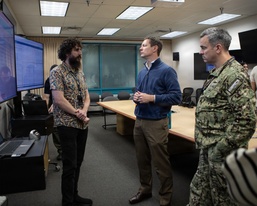
The EvenCog Action Tracker, an application developed by Naval Undersea Warfare Center Division, Keyport's Engineering and Production Enablement Branch, increases efficiency across the command's Intermediate Maintenance Activity by automating the process for tracking and submitting changes to the statuses of ordnance components.
The application replaces a manual paper-form process for tracking changes to "even cog" components, defined as anything classified as ammunition by the Navy. Every change in an even cog component’s status must be tracked and submitted to the Ordnance Information System, the Navy's authoritative database for tracking ammunition and ordnance.
Previously, IMA technicians were required to manually fill out a paper form with 20 to 30 fields for every change in a component’s status. Since the IMA averaged more than 1,000 such changes per month, this created a significant administrative burden that took focus away from core maintenance tasks.
“The less time that the technician has to spend doing these administrative taskings, the more they can focus on the actual task at hand and getting weapons out the door,” said Zachary Landaal, technical lead for the Naval Innovative Science and Engineering program-funded ECAT project. “Anytime you have to do something like that, it kind of distracts you, and the less time you are distracted, the better. I hope it just equates to a more efficient overall IMA and less of an administrative burden. That's the goal.”
With ECAT, submission forms are automatically populated with data from the Automated Process Control System, the system technicians use to guide maintenance procedures. Leveraging Amazon Web Services and the Microsoft Power Platform, ECAT creates a seamless, automated workflow where data from APCS is processed and used to create pre-populated forms. Technicians now only need to open the form in the app, verify the information is correct and submit it, a process that now takes 30 seconds or less.
Eliminating the need for manual data entry not only saves time but improves the accuracy of submissions to the OIS.
“[Technicians] go from entering the data to verifying, and that puts just that extra check in there,” said Landaal. "It puts them into a second verification role, which is going to increase the accuracy of the data going into OIS, which means less time spent having to review items that get sent back because they don't match what's in OIS. It also might flag for them something that they need to submit that they might have forgotten to do otherwise.”
According to EPE Branch Head Matt Corbo, in its first month of use ECAT has yielded half a work-year worth of time savings and completely eliminated the need for rework. Total time savings over a full year are estimated to be as high as six work-years.
“I’m really interested in being able to show that with the resources that we've got and the demand surge that we know is coming, we can support the IMA’s workload. I'm trying to find as many of those manual tasks as I can and automate them to make the process a little bit easier for our people,” said Corbo.
ECAT has been well received by those who use it. “Everyone that I've talked to absolutely thinks it's just great and everyone is very excited to have it there,” said Landaal.
Garrick Bell, development-side project leader for the EPE Branch, praised Landaal’s enterprise in developing the application.
“Previously, technicians were recording changes by hand or on a spreadsheet,” said Bell. “Zach recognized that this information didn’t have to be written down; it could be extracted from the system they're already using to maintain the weapons. That’s one less thing the technician has to do to get weapons through the door.”
Landaal is currently working to expand ECAT to cover a wider range of ordnance components, incorporate data from other key naval information systems and implement the system at additional Navy commands.
“I've got a lot of ideas for this automation to even further improve the quality of the product,” he said.
Through its automation of the even cog submission process, ECAT is directly aligned to the second and third Naval Sea Systems Command Enterprise Strategy Lines of Effort: “Generate Readiness” and “Generate, Capture and Use Data.”
-KPT-
Naval Undersea Warfare Center Division, Keyport is headquartered in the state of Washington on the Puget Sound, about 10 miles west of Seattle. To provide ready support to Fleet operational forces at all major Navy homeports in the Pacific, NUWC Division, Keyport maintains detachments in San Diego, California and Honolulu, Hawaii, and remote operating sites in Guam; Japan; Hawthorne, Nevada; and Portsmouth, Virginia. At NUWC Division, Keyport, our diverse and highly skilled team of engineers, scientists, technicians, administrative professionals and industrial craftsmen work tirelessly to develop, maintain and sustain undersea warfare superiority for the United States.